
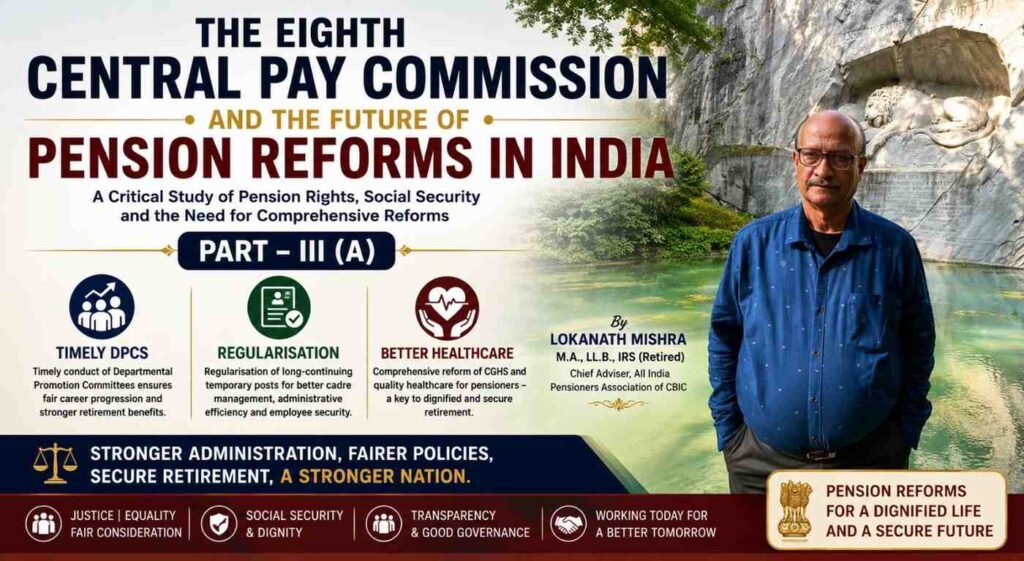
THE EIGHTH CENTRAL PAY COMMISSION AND THE FUTURE OF PENSION REFORMS IN INDIA
By Lokanath Mishra M.A., LL.B., IRS (Retired)
A Critical Study of Pension Rights, Social Security and the Need for Comprehensive Reforms:
PART – III (A)
Chapter–10
Timely Conduct of Departmental Promotion Committees (DPCs): An Essential Requirement of Good Governance
One of the important demands placed before the Government by the All India Pensioners Association of the Central Board of Indirect Taxes and Customs (CBIC) is that Departmental Promotion Committees (DPCs) should be conducted promptly against all existing vacancies.
Although this demand primarily concerns serving employees, its consequences extend far beyond the period of active service. Promotion determines not only an employee’s salary but also the computation of retirement benefits, including pension, gratuity, leave encashment and commutation. Delayed promotions therefore have a cascading effect on the financial security of retired employees.
Promotion as a Right to Fair Consideration:
The law recognises that while no employee has a fundamental right to promotion, every eligible employee has a right to be considered fairly, objectively and within a reasonable time in accordance with the applicable service rules. Delay in convening DPCs often deprives deserving employees of promotional opportunities before retirement, leading to prolonged litigation and avoidable administrative complications.
Where promotions are granted after retirement with retrospective effect pursuant to judicial or administrative orders, consequential revision of pension and retirement benefits frequently becomes necessary. Such delays not only increase litigation but also impose additional administrative burdens on Government departments.
Impact on Public Administration:
Vacant promotional posts adversely affect institutional efficiency. Senior positions requiring experience and decision-making remain unfilled, leading to increased workload on existing officers and delays in public service delivery. Regular DPCs would therefore serve the dual purpose of improving governance and ensuring that employees receive timely career progression.
Recommendation
The Eighth Central Pay Commission may recommend that:
- DPCs should ordinarily be held annually wherever vacancies exist.
- Vacancies should be identified and notified in advance.
- Time-bound schedules should be prescribed for convening DPCs.
- Administrative delays should not deprive employees of legitimate promotional consideration.
- Consequential pension revision should be processed expeditiously wherever promotions are granted with retrospective effect in accordance with law.
Such measures would reduce litigation, improve administrative efficiency and strengthen employee morale.
Chapter–11
Regularisation of Long-Continuing Temporary Posts
Another significant proposal relates to the conversion of temporary posts, including Group ‘A’ Junior Time Scale posts, into permanent posts where such posts have continued uninterrupted for more than three years.
Temporary Posts and Administrative Reality:
Temporary posts are generally created to meet short-term requirements. However, experience across Government departments shows that many such posts continue for years or even decades because the underlying administrative need becomes permanent.
When a post exists continuously over a prolonged period, performs regular governmental functions and remains essential for public administration, the distinction between temporary and permanent becomes increasingly formal rather than substantive.
Long continuation of temporary posts may affect cadre management, promotional avenues and manpower planning. It may also create uncertainty for employees and complicate long-term administrative arrangements.
Need for Periodic Review:
From the perspective of sound public administration, Government should periodically review temporary establishments. Where the need for a post has become permanent in character, consideration may be given to converting it into a permanent post after assessing workload, financial implications and organisational requirements.
Such periodic review promotes transparency and better human resource management while ensuring that sanctioned strength reflects actual administrative needs.
Balancing Administrative Necessity and Fiscal Responsibility:
Creation of permanent posts carries recurring financial implications. Consequently, any proposal for regularisation must be evaluated with reference to workload studies, functional necessity, cadre structure and budgetary constraints.
Accordingly, the Commission may recommend that every Ministry undertake a structured review of temporary posts at fixed intervals so that long-standing temporary establishments are examined objectively and appropriate decisions are taken based on administrative necessity rather than historical practice.
Chapter–12
Comprehensive Reform of CGHS and Health Care for Pensioners
Perhaps no issue causes greater concern among pensioners than access to affordable and quality healthcare.
Medical expenditure constitutes the largest recurring financial burden during old age. Increased longevity, chronic illnesses, specialised treatment and the rising cost of medicines have transformed healthcare into the most significant component of post-retirement expenditure.
For many pensioners, adequacy of medical facilities is as important as the quantum of pension itself.
Strengthening the Central Government Health Scheme:
The Association has proposed a comprehensive strengthening of the Central Government Health Scheme (CGHS), including:
- expansion of Wellness Centres,
- wider empanelment of reputed private hospitals,
- cashless treatment facilities,
- uninterrupted supply of prescribed medicines,
- opening of Wellness Centres in important tourist destinations, and
- simplification of administrative procedures.
These proposals reflect concerns frequently expressed by pensioners regarding accessibility, availability and continuity of medical care.
Expansion of Wellness Centres:
At present, CGHS facilities are concentrated primarily in notified cities. Many retired employees reside in districts or smaller towns where CGHS facilities are unavailable or limited. This often compels elderly pensioners either to travel long distances or to depend upon reimbursement procedures that may involve delays.
The Government may therefore examine, in a phased manner, the feasibility of expanding CGHS services to additional districts based on the concentration of beneficiaries, availability of infrastructure and financial resources.
The proposal to establish Wellness Centres at important tourist destinations is intended to ensure that pensioners travelling within the country have reasonable access to medical assistance. Whether such centres should be established at every tourist destination or according to objective criteria is a matter for administrative assessment.
Empanelment of Hospitals:
Modern healthcare increasingly depends upon specialised hospitals equipped with advanced diagnostic and therapeutic facilities.
Greater empanelment of reputed private hospitals, subject to transparent quality standards and reasonable package rates, could enhance accessibility and reduce hardship faced by pensioners requiring specialised treatment.
At the same time, expansion of empanelment should be accompanied by appropriate safeguards relating to quality, accountability and cost control.
Cashless Treatment:
Cashless treatment has emerged as one of the most important expectations of elderly pensioners.
Many retired employees cannot readily arrange substantial sums for emergency medical treatment. Cashless facilities reduce financial stress at a time when immediate medical intervention is critical.
Accordingly, the Government may consider expanding cashless treatment arrangements through a wider network of empanelled hospitals while maintaining appropriate financial safeguards.
Availability of Medicines:
The Association has emphasised that medicines prescribed by specialists should ordinarily be supplied without unnecessary substitution except where clinically appropriate and consistent with applicable medical guidelines. It has also urged that indented medicines be made available promptly to avoid interruption of treatment.
Continuity of medication is especially important for chronic illnesses such as diabetes, hypertension, cardiovascular diseases and cancer. Administrative delays in supplying essential medicines may adversely affect treatment outcomes.
The Commission may therefore recommend strengthening procurement systems, improving inventory management and ensuring timely availability of essential medicines through digital monitoring and efficient supply chains.
Health Security as Social Security:
Healthcare is inseparable from retirement security.
A pension system cannot be regarded as adequate merely because it provides monthly financial assistance. Without effective access to affordable healthcare, the real value of pension is substantially diminished.
Accordingly, medical welfare should be recognised as an integral component of pension policy rather than as a separate administrative matter.
Conclusion to Part–III (A)
The demands relating to timely DPCs, rational cadre management and comprehensive healthcare reforms reflect broader concerns regarding administrative efficiency and the welfare of retired public servants.
The Eighth Central Pay Commission may appropriately examine these issues in consultation with the concerned Ministries and stakeholders, keeping in view constitutional values, administrative efficiency and fiscal sustainability.
A responsive pension system must address not only financial security but also career progression during service and access to quality healthcare after retirement. Together, these measures can contribute significantly to preserving the dignity, independence and well-being of Government employees and pensioners throughout their lives.
(Part–III(B) will examine pension parity, the implementation of the 7th Central Pay Commission’s Option-1 proposal, recommendations of Parliamentary Committees on periodic pension revision and CGHS expansion, followed by the editorial summary and concluding recommendations.)