

The government now says present pensioners will be covered under 8th Central Pay Commission (8th CPC) recommendations — but there is legitimate ambiguity in the wording of the Terms of Reference (ToR), which fuels concern and sometimes criticism (“halla-gulla”) from pensioner / employee groups.
( by Lokanath Mishra, the Chief Adviser, The All India Pensioners Association of CBIC)
Here’s why there is confusion / debate — and what seems to be the current official position:
What the Government / Official Clarifications Say
• When asked in Parliament (Rajya Sabha), the Government stated unequivocally: “The 8th CPC will make its recommendations on … pension, etc. of the central government employees.” 
• This was understood by many pensioner- and employee-bodies as a formal assurance that pension revision for existing (pre-2026) pensioners will be part of 8th CPC’s mandate. 
• Some senior officials have also stated that pension & family-pension revision under 8th CPC will protect the interests of all pensioners and family pensioners — i.e. not only future retirees, but also the 69 lakh+ existing pensioners. 
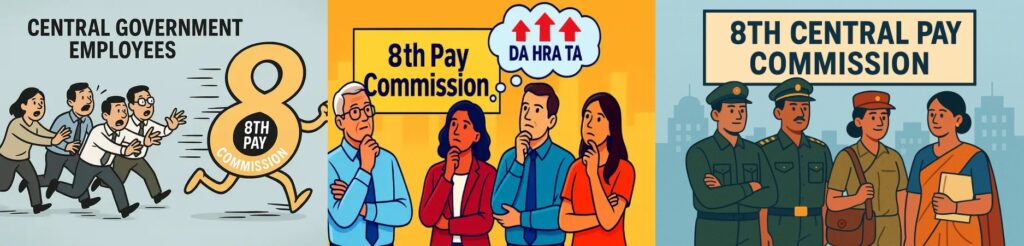
So, as of early December 2025, the official line is that present pensioners are not being excluded. 
Why Many Pensioner / Employee Groups Still Fear Exclusion — Where the Ambiguity Lies
Despite the official clarifications, there remain several valid grounds for concern:
• The published Terms of Reference (ToR) for 8th CPC did not explicitly mention “revision of pension for those already retired.” That was different from earlier pay commissions: under the 7th CPC, ToR explicitly covered pension revision for retirees prior to the effective date. 
• There is no clearly specified “date of effect” in the ToR. Previous pay commissions used a defined date from which their recommendations applied (e.g. 1 January 2016 for 7th CPC). Absence of such a date creates uncertainty about whether pension revision would apply retroactively to past pensioners or only to those retiring after 8th CPC implementation. 
• The ToR refers to “unfunded cost of non-contributory pension schemes,” which some pensioner bodies interpret as a hint towards a fiscal-prudence approach rather than a welfare-driven approach. They fear pensioners may be treated as a “liability” rather than beneficiaries of rightful revision. 
• Because of these omissions and wording changes, many pensioner organisations (e.g. All India Defence Employees’ Federation — AIDEF, Confederation of Central Government Employees & Workers — CCGEW, Bharat Pensioners’ Samaj — BPS) , The All India Pensioners Association of CBIC, ( AIPA of CBIC) have formally objected and demanded clearer, more explicit assurance for “all existing pensioners and family pensioners.” 
Because of this — even though there is a public assurance — pensioners have reason to worry: if the final 8th CPC recommendations or the government’s implementation order interprets the ToR narrowly, retirees could get left out or get lesser benefits.
Why Critics / “Anti-Government” Voices Are Raising Loud Objections
Given the ambiguity, critics and some pensioner organisations are vocal (making “halla-gulla”) for several reasons:
• They see the omission of explicit coverage of “pre-2026 retirees” in ToR as a deliberate attempt to exclude old pensioners — especially given that earlier pay-commissions (like 7th CPC) explicitly protected them.
• The lack of a defined “date of effect” adds uncertainty: critics fear government may pick a date that excludes past retirees or delay implementation until after future elections.
• They worry that the reference to “unfunded cost” shifts perspective: pension becomes a “financial burden” rather than a right earned by employees — which may reflect in minimal increases, delays, or even structural changes (e.g. reducing benefits, revising formulas, or favouring newer retirees).
• Some distrust the government’s track record: given past delays or partial implementation (allowances, DA, restoration of commuted portion, etc.), pensioners fear that even if the 8th CPC includes them, benefits may come with long delay, caveats or diluted amounts.
In short: the combination of ambiguous language + fiscal-speak + historical distrust fuels loud objections.
My Assessment — What Looks Likely (Based on Current Info)
• It seems the government intends to include pension revision for existing pensioners under 8th CPC — the public statements admit “pension” as a covered item.
• Yet, because of ambiguous/missing phrasing in the ToR and no fixed “date of effect,” it remains possible (though maybe unlikely) that actual benefit might vary depending on how 8th CPC and subsequent government order is framed.
• So — while pensioners should not panic (as of now), it is reasonable to stay vigilant: monitor 8th CPC report, any formal government notification, and how “pension revision” is defined/implemented.
A Decade of Purpose After Retirement (1 December 2015 – 30 November 2025)
Why Courts Were Not Approached for the 18-Month DA Freeze: Extending the Constitutional and Legal Logic Explained Earlier
The Validation Clause in the Finance Bill (Pensions): history, text, merits, demerits, FM’s clarification and likely legal outcomes
Will DA Stop After 2025 ? A Simple Explainer on 8th Pay Commission, Past Practices, and Legal Background