
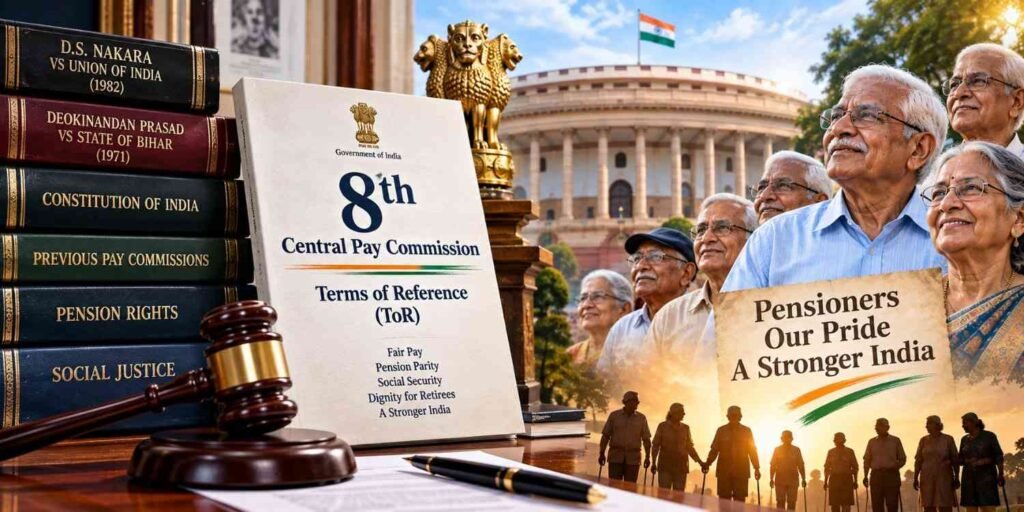
ToR is the Scope and Jurisdiction of CPC – Past Court Judgments Alone Will Not Give Pension Revision Unless ToR is Amended:
By Lokanath Mishra, The Chief Adviser, AIPACBIC.
Pensioners should keep this in mind very clearly that the Pay Commission will recommend only with reference to Terms of Reference and not on the basis of any past judgment of Court of Law, and Government while implementing the recommendations of CPC will consider only the recommendations of CPC. This statement is 100% legally correct and that is why pensioners are in grave danger today.
Let us understand the constitutional and administrative position clearly:
- Pay Commission is a creation of Government and its Scope, Function and Jurisdiction are based upon ToR, not a Court:
The Central Pay Commission is not a Court of Law. It is not a Tribunal. It is an Executive Body constituted by a Resolution of the Government of India under Article 309 and executive powers.
Its entire existence, its scope, its function, its jurisdiction is strictly circumscribed and limited by what is written in the Terms of Reference notified by the Ministry of Finance.
The ToR is like a Charter or a Boundary Wall for the Commission. The Commission can work only within that wall. It cannot cross that wall under any circumstances.
The Commission cannot travel beyond ToR. It cannot say “Though ToR does not say about pre-2026 pensioners, I will still recommend because Supreme Court said in Nakara case that pensioners are one class.” If it does so, its recommendation will be held ultra vires, beyond jurisdiction and will be summarily rejected by the Government as without authority.
The Government has appointed the Pay Commission, Government has fixed its ToR, and Government has also fixed a time limit. The Chairman and Members are bound by oath to act within ToR only.
Therefore, quoting D.S. Nakara 1982, or Deokinandan Prasad 1971, or any judgment of CAT, High Court or Supreme Court before the Pay Commission is legally useless and infructuous unless the ToR itself explicitly empowers the Commission to deal with existing pensioners.
In past Commissions – 5th CPC Para 1.15, 6th CPC ToR Para 2(e), 7th CPC ToR Para 2(f) – there was a specific and explicit mandate: “To examine the principles which should govern the structure of pension, death-cum-retirement gratuity, family pension and other terminal benefits and to recommend revision with need to maintain parity between past and future pensioners.”
In the present 8th CPC ToR, Point 2(e) is deliberately made vague. It does not contain the words “existing pensioners”, “pre-2026 pensioners”, “parity between past and future pensioners”. This is a calculated omission to keep 65 lakh pre-2026 pensioners and family pensioners outside the purview of 8th CPC.
- Government is Bound to Consider Only CPC Recommendations, Not Court Judgments Directly While Implementing the Recommendations of CPC
As per established procedure under the Transaction of Business Rules, Government’s action on pay and pension revision flows only from the Report of the Pay Commission.
The process is: CPC submits Report -> Department of Expenditure examines it -> Empowered Committee of Secretaries scrutinizes it -> Cabinet approves it -> Department of Pension & Pensioners’ Welfare issues Pension Revision Orders.
At no stage does the Government directly implement a Court judgment while implementing Pay Commission Report unless the ToR directs the Commission to keep the principles laid down by Courts in view.
The Department of Expenditure will simply take a one-line stand: “8th CPC did not recommend for pre-2026 pensioners because it was not in ToR, hence no revision is admissible.”
This is exactly what the Government wants to do now. By keeping Point 2(e) vague and not explicitly including “revision of pension of all pre-01.01.2026 pensioners with parity”, the Government has created a perfect legal escape route.
Later, when pensioners go to CAT or High Court, Government will argue in Court with full force that:
(a) The Expert Body – 8th CPC – constituted with eminent members, after detailed deliberation, consciously did not recommend for past pensioners.
(b) Government cannot go beyond Expert Body’s recommendation and create a financial liability of Rs. 1.5 lakh crore.
(c) After the Finance Act 2025 validating pension rules, Government has statutory power to classify pensioners based on cut-off date.
The Courts may take 5 to 10 years to decide and in the meantime, lakhs of old pensioners will leave this world without getting justice. The Government knows that a 75 year old pensioner cannot fight a long legal battle in Supreme Court.
The DoPT OM dated 18.08.2026 forwarding representations to DoE is being celebrated by some as a victory. Legally it has no value. Forwarding is not approval. It is not amendment. Till a Gazette Notification amending ToR is issued, pre-2026 pensioners remain excluded.
- Therefore, Amending ToR is the Only Remedy – And Judgments Are Our Weapon for That
Hence, we must put pressure for amendment of ToR, and for that pressure, past judgments are our strongest and only weapon.
We must cite before the Government and before DoE, not before CPC, the following:
- D.S. Nakara vs Union of India (1982) AIR SC 130 – 5 Judge Bench: Pension is not a bounty, not a gratuitous payment dependent on sweet will of employer. It is a deferred wage, a right earned by long service. Pensioners form one class and classification based on date of retirement is arbitrary, discriminatory and violative of Article 14 and 16 of Constitution.
- Deokinandan Prasad vs State of Bihar (1971) SC: Pension is a Constitutional Right under Article 300A and not mere concession. Right to pension is right to property.
- Principle of Parity Established by Successive CPCs: 5th CPC gave full parity, 6th CPC gave modified parity with fitment of 2.26, 7th CPC gave Option-1 parity with fitment of 2.57. How can 8th CPC suddenly deny parity to pre-2026 pensioners? This is against legitimate expectation.
But this citation should not be made before the Pay Commission after its constitution – it will be too late then. It must be made NOW, before DoPT and DoE, through emails, speed post, representations to PM, FM, Revenue Secretary, to compel them to amend ToR before the Commission starts functioning.
If ToR is not amended now, no court judgment of the past will automatically come to rescue of lakhs of pensioners. Each pensioner will have to file individual writs and fight for 10 years, which is impossible for a 70-80 year old pensioner.
Conclusion
The law is simple and brutal:
Pay Commission goes by ToR, Government goes by Pay Commission Report.
So if pre-2026 pensioners are not in ToR, they will not be in Report, and will not be in Government Order. Result – NO REVISION, only DR.
Hence our entire fight must be for ONE SINGLE DEMAND:
Amend Point 2(e) of ToR of 8th CPC to explicitly include “examination and recommendation for revision of pension of all existing pensioners who retired / died before 01.01.2026 with full parity as per principles laid down in D.S. Nakara case.”
For this, we must use Court Judgments as pressure tactics upon Government TODAY, not as arguments before Pay Commission TOMORROW.
Let us wake up, write letters and compel Government to amend ToR.