
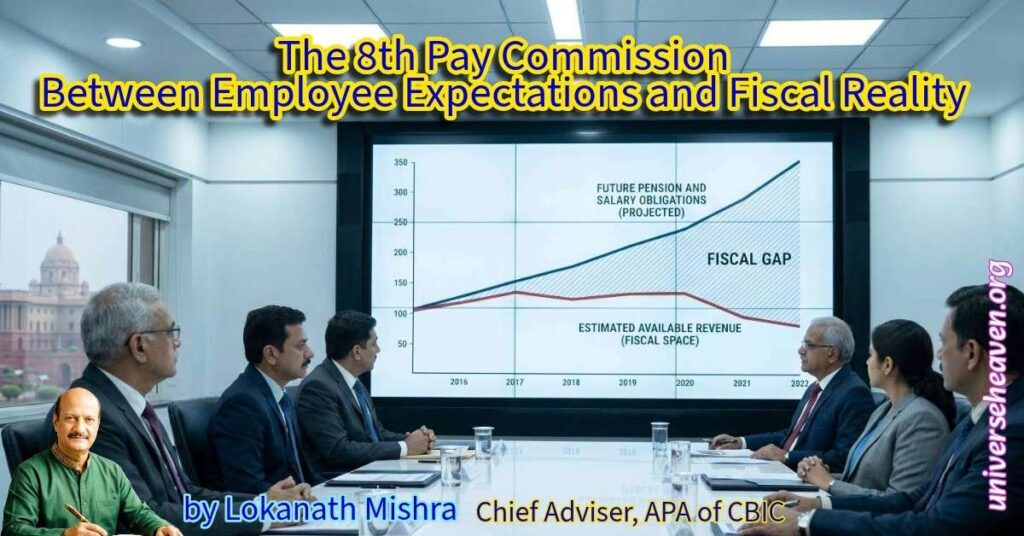
The 8th Pay Commission : Between Employee Expectations and Fiscal Reality
By Lokanath Mishra
Chief Adviser, APA of CBIC
The announcement of the Eighth Central Pay Commission has once again ignited expectations among more than one crore serving and retired Central Government employees. As consultations proceed and recommendations are expected by May 2027, discussions are increasingly centering on a single figure—the fitment factor that will determine the extent of salary and pension revision.

Employee organizations have naturally demanded a substantial increase. Their argument is not without merit. Since the implementation of the Seventh Central Pay Commission in 2016, cumulative inflation has significantly eroded the purchasing power of government salaries and pensions. Rising costs of housing, healthcare, education, transportation, and daily necessities have placed increasing pressure on middle-class households. In real terms, government employees today are not enjoying the same purchasing power that they possessed a decade ago.
Economic analysts estimate that inflation since 2016 has been around 56 percent. On this basis, some experts suggest that a fitment factor of approximately 2.86 may merely restore lost purchasing power rather than provide any extraordinary gain. Employee federations, however, are demanding even higher multiples, arguing that a pay revision should not only compensate for inflation but also enhance motivation, productivity, and social security.
Yet the issue cannot be viewed solely from the perspective of employees.

The Government today operates in an economic environment very different from that which existed during previous Pay Commissions. Massive expenditure commitments are being made towards infrastructure, defence modernization, digital governance, energy transition, social welfare, and capital investment. India seeks to maintain high growth rates while simultaneously preserving fiscal discipline and controlling inflation.
Any significant increase in salaries and pensions carries substantial financial consequences. Even a modest increase in the fitment factor can translate into lakhs of crores of additional expenditure over time. A large enhancement would not only increase current salary liabilities but would also permanently raise future pension obligations.
This reality suggests that the Government may approach the recommendations of the Eighth Pay Commission with caution. Unlike earlier decades when expansionary fiscal policies were more common, the present policy environment emphasizes fiscal prudence, targeted welfare, and productive capital expenditure. Policymakers are likely to ask whether scarce public resources should be directed toward higher recurring salary commitments or toward infrastructure and developmental investments that benefit the wider population.

Recent judicial trends also provide an interesting backdrop.
Courts increasingly appear reluctant to interfere with policy decisions involving complex economic, financial, and actuarial considerations. The recent Delhi High Court judgment upholding the fifteen-year restoration period for commuted pensions illustrates this approach. The Court emphasized that policy choices based on expert evaluation should not be disturbed merely because alternative calculations may appear more attractive to affected individuals.
This judicial philosophy reflects a broader recognition that economic policymaking belongs primarily to expert bodies and elected governments. Consequently, if the Eighth Pay Commission recommends a fitment factor lower than employee expectations, judicial intervention is unlikely unless there is clear evidence of arbitrariness or constitutional infirmity.
For this reason, government employees should perhaps moderate expectations of a dramatic salary windfall.
Historically, the Sixth Pay Commission introduced a fitment factor of 1.86, while the Seventh Pay Commission raised it to 2.57. Many employee organizations are now seeking figures above 3.0. However, given current fiscal realities, the Government’s emphasis on expenditure discipline, and the broader macroeconomic environment, a recommendation significantly below employee demands appears more probable.
The Commission is likely to seek a middle path—one that partially restores purchasing power without imposing an unsustainable burden on the exchequer. Such an approach would be consistent with prevailing economic priorities and administrative thinking.
At the same time, employees should not underestimate the importance of arrears. If implementation occurs after the Commission submits its report in 2027 and recommendations are made effective retrospectively, arrears for nearly two years could provide a substantial one-time financial benefit. Such payments may partially offset disappointment arising from a lower-than-expected fitment factor.

The broader question is whether government compensation should continue to be assessed primarily through periodic pay revisions. Future reforms may increasingly focus on performance incentives, targeted allowances, healthcare support, pension security, and work-life improvements rather than large across-the-board salary increases.
The Eighth Pay Commission therefore stands at the intersection of competing priorities. Employees seek protection from inflation and an improvement in living standards. The Government seeks fiscal sustainability and continued investment in national development. The Commission’s task will be to reconcile these legitimate but competing objectives.
The final outcome may leave neither side completely satisfied. Yet that very outcome may represent the most realistic and responsible path forward in an era where economic prudence has become as important as economic growth itself.