
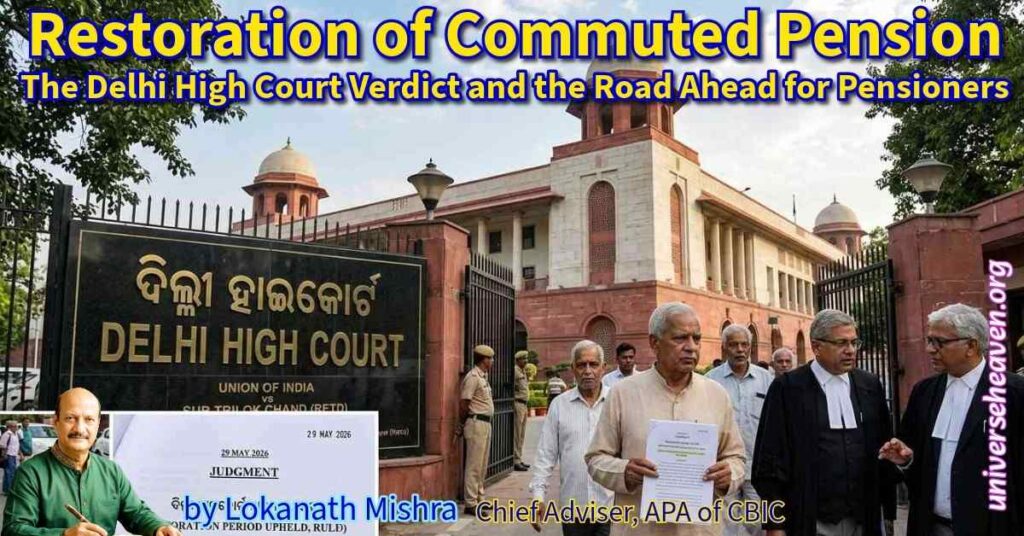
Restoration of Commuted Pension : The Delhi High Court Verdict and the Road Ahead for Pensioners
By Lokanath Mishra, Chief Adviser, APA-CBIC
The issue of restoration of the commuted portion of pension has remained a matter of concern for lakhs of pensioners across India for several decades. Pensioners from the Defence Services, Central Government departments, Railways, Central Armed Police Forces and other organizations have consistently argued that the period prescribed for recovery of the commuted portion of pension is unduly long and requires reconsideration in the light of changing economic realities.
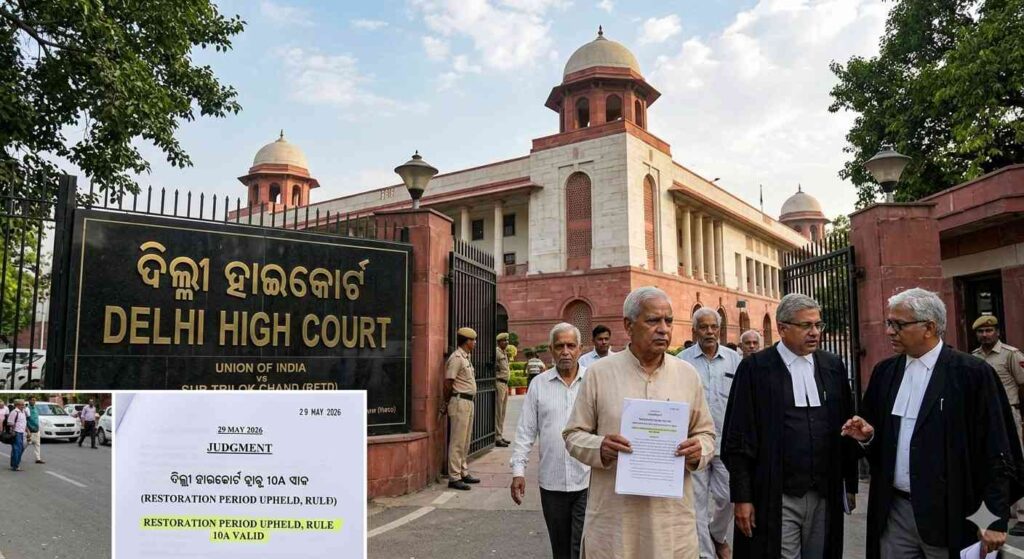
A recent judgment of the Delhi High Court delivered on 29 May 2026 in Union of India & Others vs. Sub Trilok Chand (Retd.) & Others and connected matters has once again brought this important issue into focus. The Court upheld the existing rule that provides for restoration of the commuted portion of pension only after completion of fifteen years. The judgment has significant implications for pensioners and pensioners’ organizations throughout the country.
Understanding Pension Commutation
Pension commutation is a facility that enables a retiring employee to receive a lump-sum amount by surrendering a specified portion of his or her monthly pension. The facility is often utilized to meet immediate financial requirements at the time of retirement, such as repayment of loans, construction of a house, marriage of children, education expenses, or medical needs.
In return for receiving the lump-sum amount, a portion of the monthly pension is deducted for a prescribed period. Under the existing rules applicable to Central Government pensioners, the commuted portion is restored only after fifteen years.
For many years, pensioners have maintained that the commuted amount is substantially recovered by the Government within approximately eleven to twelve years. Consequently, they contend that deductions beyond that period amount to excess recovery.

The Challenge Before the Delhi High Court
Various pensioners and pensioners’ associations approached the Delhi High Court challenging Rule 10A of the CCS (Commutation of Pension) Rules, 1981.
The principal arguments advanced by the petitioners were:
- The actual value of the commuted pension is recovered within about 11 to 12 years.
- Continuation of deductions for fifteen years causes financial hardship to retired employees.
- The fifteen-year period is arbitrary and requires reduction.
- Certain State Governments and organizations have adopted shorter restoration periods.
- Advances in actuarial science and changes in economic conditions justify a fresh review of the existing policy.
The petitioners sought judicial intervention to direct restoration of the commuted portion after twelve years instead of fifteen years.
Findings of the Court
After considering the submissions of all parties, the Delhi High Court rejected the challenge and upheld the validity of the fifteen-year restoration period.

The Court observed that pension commutation is a voluntary option. A pensioner who chooses to commute a portion of pension accepts the terms and conditions of the scheme. The Court further held that pension commutation cannot be viewed merely as a loan transaction involving simple recovery calculations.
According to the Court, the scheme is based on actuarial principles involving life expectancy, mortality assumptions, interest rates, financial sustainability and long-term governmental liabilities. These considerations fall within the domain of policy-making and expert evaluation.
The Court also noted that where a pensioner dies before the completion of fifteen years, the Government does not recover any balance amount from the family, while family pension continues independently. Therefore, the Government bears certain financial risks under the scheme.
A crucial factor influencing the judgment was the reliance placed upon the decision of the Supreme Court in Common Cause v. Union of India, where similar arguments regarding restoration after approximately twelve years had been considered and rejected.
The Court further observed that successive Central Pay Commissions, including the Sixth and Seventh Central Pay Commissions, had not recommended any reduction in the restoration period.
Why Pensioners Are Concerned
Although the judgment is legally significant, it has disappointed many pensioners who were hoping for relief.
For a large number of retirees, pension is the primary source of livelihood. Rising medical expenses, inflation and increasing costs of living place substantial financial pressure on senior citizens. Many pensioners believe that restoration of the commuted portion at an earlier stage would provide meaningful financial support during their later years.
Another concern arises from the perception that the present system does not adequately reflect current economic realities. Mortality patterns, interest rates and actuarial assumptions have changed considerably over the past several decades. Pensioners therefore feel that the existing scheme deserves fresh examination.
Scope for Further Review
The Delhi High Court judgment undoubtedly represents a major legal hurdle for those seeking reduction of the restoration period. Nevertheless, the debate is unlikely to end.
The issue may still be examined from the perspective of updated actuarial data, constitutional principles of fairness and equality, and evolving socio-economic conditions. Pensioners’ organizations may continue to advocate for a policy review through representations to the Government, the Department of Pension and Pensioners’ Welfare, and future Pay Commissions.
The matter is not merely a question of financial calculations. It also concerns the welfare and dignity of retired employees who have devoted their lives to public service.
The Way Forward
The judgment has reaffirmed the legal validity of the existing fifteen-year restoration period. However, legal validity does not necessarily preclude policy reform.
A comprehensive review by an independent expert committee consisting of actuaries, economists, pension administrators and representatives of pensioners may help determine whether the current restoration period continues to be justified under present conditions.
Such a review could examine:
- Current life expectancy trends.
- Interest rate structures.
- Fiscal implications for the Government.
- Comparative practices adopted by States and other organizations.
- The financial needs of senior citizens in contemporary India.
A balanced approach that protects public finances while ensuring fairness to pensioners would serve the larger public interest.
A Constructive Agenda for the Eighth Central Pay Commission
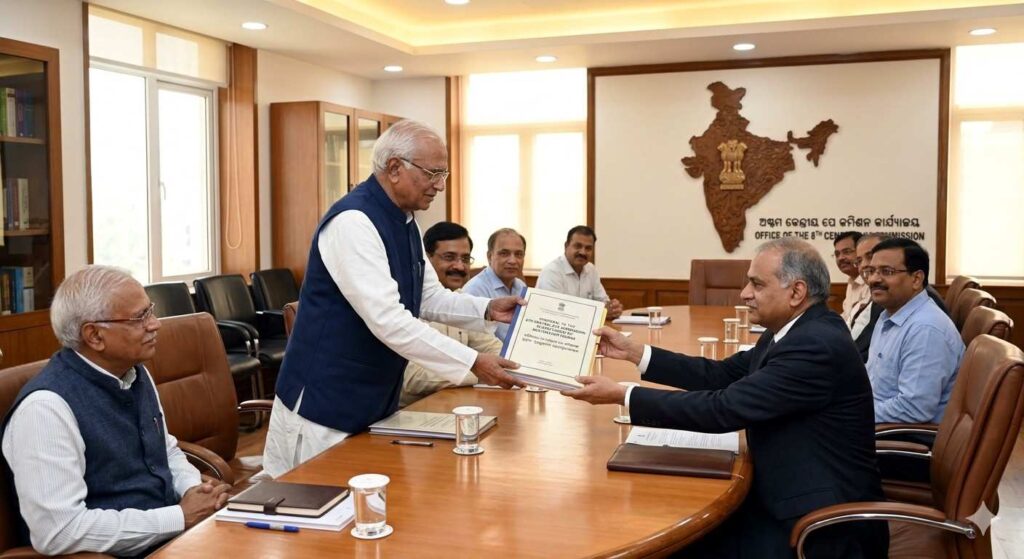
While the Delhi High Court has upheld the legality of the fifteen-year restoration period, the forthcoming Eighth Central Pay Commission presents an appropriate forum for a comprehensive review of the pension commutation scheme. Unlike courts, which are bound by existing legal principles and precedents, a Pay Commission has the mandate to examine evolving socio-economic realities, demographic changes and the welfare needs of pensioners.
Pensioners’ associations may therefore place before the Eighth Central Pay Commission a reasoned proposal for reassessment of the commutation factor and the restoration period based on current actuarial data, life expectancy trends, prevailing interest rates and fiscal implications. The objective need not be confined to a reduction from fifteen years to twelve years; rather, it should focus on developing a fair, transparent and scientifically updated framework that balances the interests of pensioners and the Government.
The Eighth Central Pay Commission may also consider commissioning an independent actuarial study to determine the actual period required for recovery of the commuted value under present conditions. Such an evidence-based approach would help remove long-standing doubts and ensure that the commutation scheme remains equitable, financially sustainable and responsive to the expectations of millions of retired employees and their families.
Conclusion
The Delhi High Court’s judgment of 29 May 2026 has settled, for the present, the legal challenge to the fifteen-year restoration period for commuted pension. The Court has treated the issue as a matter of actuarial and economic policy and has relied upon established Supreme Court precedent.
Yet the concerns raised by pensioners remain genuine and deserve thoughtful consideration. Pension is not merely a financial entitlement; it represents social security earned through decades of dedicated service. As India moves towards a more inclusive and welfare-oriented society, continuous review of pension policies is both necessary and desirable.
The discussion on restoration of commuted pension may therefore continue in policy forums, pensioners’ associations and 8th Pay commission, with the ultimate objective of ensuring justice, dignity and financial security for the nation’s retired employees.
Not withstanding the judgement of Delhi High Court citing Supreme Court’s earlier ruling on this issue some very important things like reduction in interest rates and inflation has not been taken into consideration. The justice system must consider the present scenario in this respect. A lot of changes to the Apex Court has been reversed by it as the old system can’t prevail for ever. Will the judges agree with abolition of the Collegium system which is a new phenomenon and reeks about nepotism having a bearing on the eroding the faith of common man on judiciary. Now the next course of action should be to prevail upon our MPs to raise this in the Parliament and we should also consult some knowledgible legal advisors to challenge this order of Delhi High Court in the Supreme Court.