
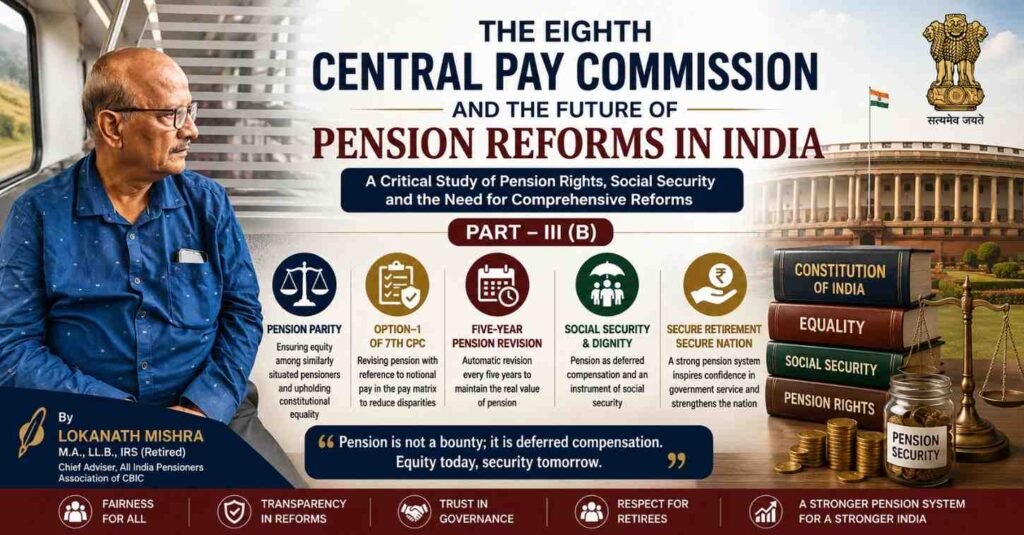
THE EIGHTH CENTRAL PAY COMMISSION AND THE FUTURE OF PENSION REFORMS IN INDIA:
By Lokanath Mishra M.A., LL.B., IRS (Retired)
A Critical Study of Pension Rights, Social Security and the Need for Comprehensive Reforms:
PART–III (B)
Chapter–13
Pension Parity: The Constitutional Imperative and the Case for Implementing Option–1 of the Seventh Central Pay Commission:
Among all the issues presently engaging the attention of pensioners’ organisations throughout the country, none has generated greater discussion than the question of pension parity. The All India Pensioners Association of the Central Board of Indirect Taxes and Customs (CBIC), along with several other recognised pensioners’ organisations, has consistently urged the Government to ensure that pensioners who retired decades earlier should not receive substantially lower pensions than similarly situated pensioners who retired subsequently from the same post merely because of the date of retirement.
The demand is founded upon the broader principle that pension represents deferred compensation for service rendered to the State. While the amount of pension may legitimately vary depending upon qualifying service and applicable statutory rules, wide disparities between similarly situated retirees often give rise to concerns regarding equity and the continuing relationship between pension and the emoluments attached to the post from which the employee retired.
The landmark judgment of the Supreme Court in D. S. Nakara v. Union of India recognised pension as a valuable right flowing from long and faithful service and emphasised that pension policy should conform to the constitutional guarantee of equality. Although subsequent judicial decisions have explained the scope of Nakara in different contexts, the judgment continues to represent an important constitutional milestone in Indian pension jurisprudence.
The Concept of Pension Parity:
Pension parity does not necessarily mean that every pensioner should receive exactly the same pension irrespective of service, rank or qualifying years. Rather, it embodies the principle that pension should maintain a fair and rational relationship with the pay attached to the post and should not become disproportionately inadequate merely because the employee retired before a particular cut-off date.
In practical terms, pension parity seeks to reduce arbitrary disparities between pensioners holding the same post and possessing comparable qualifying service.
The Seventh Central Pay Commission and Option–1:
During the deliberations of the Seventh Central Pay Commission, different methodologies for revision of pensions were examined. One of these, commonly referred to as Option–1, contemplated revision of pension broadly with reference to the notional pay of a serving employee in the corresponding pay matrix level.
Many pensioners’ organisations have continued to advocate reconsideration of this methodology on the ground that it would substantially reduce disparities between past and future retirees.
The principal arguments advanced in support of such an approach include:
- preservation of a reasonable relationship between pension and current pay levels;
- reduction of anomalies among similarly placed pensioners;
- simplification of future pension revision exercises;
- greater transparency in pension fixation; and
- reinforcement of the principle that pension is deferred compensation rather than a fixed historical amount.
It is recognised that implementation of any such methodology would have financial implications. Consequently, the Eighth Central Pay Commission may undertake a detailed actuarial and fiscal examination before making recommendations.
Pension Revision Every Five Years:
Another proposal receiving increasing support is the introduction of automatic pension revision at intervals of five years instead of waiting for the next Pay Commission.
This proposal is based on several considerations.
First, the interval between successive Pay Commissions has effectively become too long in an economy experiencing continuous inflation and rapidly rising healthcare costs.
Secondly, advances in medical science have increased life expectancy. Pensioners therefore remain dependent upon retirement income for a much longer period than in earlier decades.
Thirdly, the purchasing power of pension steadily declines despite Dearness Relief because several components of age-related expenditure—particularly healthcare—rise faster than general inflation.
Periodic revision every five years could therefore help maintain the real value of pension while avoiding sudden large revisions after a decade or more.
The precise methodology for such revision would naturally require detailed financial examination and consultation with stakeholders.
Pension as an Instrument of Social Security:
Modern democratic societies increasingly recognise that pension policy is not merely an accounting exercise.
A sound pension system contributes to social stability, economic security and public confidence in Government service.
Young entrants to Government service derive confidence from knowing that the State will provide reasonable financial protection after retirement. Equally, retired employees remain valuable members of society whose experience and institutional memory continue to benefit the nation.
Investment in pension security should therefore be viewed not merely as expenditure but as fulfilment of the State’s continuing obligation towards those who have devoted decades of their lives to public service.
Recommendation:
In light of these considerations, the Eighth Central Pay Commission may undertake a comprehensive examination of:
- the concept of pension parity;
- the methodology examined under the Seventh Central Pay Commission’s Option–1;
- mechanisms for automatic pension revision at shorter intervals;
- the financial implications of alternative models; and
- measures to reduce disparities among similarly situated pensioners while maintaining fiscal sustainability.
A balanced solution based upon constitutional values, administrative practicality and financial responsibility would strengthen confidence in India’s pension system and promote greater equity among present and future pensioners.
⸻
(To be continued with Chapter–14 on Parliamentary Committee Recommendations and Chapter–15 on Emerging Issues including LTC, HRA, retrospective promotion, overseas medical insurance, annual pension enhancement and digital pension administration.)
It ie a Apt recommendation
Rakesh Chandra Srivastava
August 9, 2026 at 11:04 pm
सातवें वेतन आयोग में ग्रेड पे 4200 एवं 4600 का पे मैट्रिक्स की शुरुवात काफी घटाकर की गई थी जिसकी भरपाई तत्समय कार्यरत कर्मचारियों ने अपने सेवाकाल कम वेतन प्राप्त करके में एवं रिटायर होने के बाद कम पेंशन लेकर कर रहे है।
आठवें वेतन आयोग में आवश्यकता है 4200,4600 एवं4800 के ग्रेड पे को मिलाकर एक ग्रेड पे किया जाय। और पे मैट्रिक्स की शुरुवात उसी अनुपात में किया जाय जैसे इसके ऊपर के ग्रेड पे में होगा ।ताकि वर्तमान में कार्यरत कर्मचारियों के साथ न्याय हो और रिटायर्ड कर्मचारी अपने आँसू पोंछ सके।
Grade Pay was revised and a few of jr colleagues got the benefits of the same dept (EME) while me being promoted to Gazetted Gp B didn’t get anything. Whether justified or not us left to Pay commission. I do hope justice will prevail
Grade Pay was revised and a few of jr colleagues got the benefits of the same dept (EME) while me being promoted to Gazetted Gp B didn’t get anything. Whether justified or not is left to Pay commission. I do hope justice will prevail
I do agree
It ie an Apt recommendation
Agreed with the concept of auto revision of pension @five years of interval because it will increase our zeal to survive with command. It would seem ,we would not become the burden of the society. So, remember Film Anand – Babumashai, zindegi lambi nehi ,Bari hona chahiy .
Agar Zina Hai to shar uthake jio . Jay Hind.
Ra
Parity of pension between the pensioners retired earlier and the present retiring now in the same rank should be ensured .
Many many thanks for favour of pensioners. It will like wise a better suggestion and also a valuable solution for pensioners. Thanks a lot. Gunanidhi Patra. pensioner. Dhenkanal Odisha. gunanidhipatragmale.cum
RPWD PROMOTION DEAF AND DUMB YOU.
TRANSPORT ALLOWANCE DEAF DUMB THE IDEA OF THERE ARE YOU.
Superannuation cases 60 percentage of basic pay as basic pension after attending the age 60 years. 70 percentage of basic pay as basic pension after attending the age of 65 years and 80 percentage of basic pay as basic pension after attending the age of 70 years 90 percentage age 75 years and 100 percentage age 80 years.
Do not waste time it is late and the Amount to give is big
𝐑𝐞𝐯𝐢𝐬𝐢𝐨𝐧 𝐨𝐟 𝐩𝐞𝐧𝐬𝐢𝐨𝐧 𝐭𝐨 𝐚𝐥𝐥 𝐜𝐚𝐭𝐨𝐠𝐨𝐫𝐲 𝐨𝐟 𝐑𝐞𝐭𝐢𝐫𝐞𝐝 𝐨𝐟𝐟𝐢𝐜𝐢𝐚𝐥𝐬 𝐦𝐚𝐲 𝐛𝐞 𝐠𝐚𝐳𝐞𝐭𝐞𝐝 𝐨𝐫 𝐜𝐥𝐚𝐬𝐬 𝐈𝐕, 𝐮𝐧𝐝𝐞𝐫 𝐕𝐈𝐈𝐈 𝐭𝐡 𝐏𝐚𝐲 𝐜𝐨𝐦𝐧. 𝐓𝐡𝐞𝐲 𝐜𝐚𝐧 𝐥𝐢𝐯𝐞 𝐰𝐢𝐭𝐡 𝐜𝐨𝐦𝐟𝐨𝐫𝐭 𝐥𝐨𝐯𝐞𝐥𝐢𝐰𝐨𝐨𝐝. 𝐛𝐞𝐜𝐚𝐮𝐬𝐞 𝐭𝐡𝐞𝐲 𝐚𝐫𝐞 𝐬𝐞𝐫𝐯𝐞𝐝,𝐦𝐚𝐱𝐢𝐦𝐮𝐦 𝐬𝐚𝐜𝐫𝐢𝐟𝐢𝐞𝐝 𝐦𝐨𝐫𝐞. 𝐈𝐧𝐝𝐢𝐚𝐧 𝐧𝐚𝐭𝐢𝐨𝐧𝐚𝐥 𝐥𝐨𝐯𝐞𝐥𝐢𝐰𝐨𝐨𝐝 𝐛𝐞𝐥𝐢𝐯𝐞𝐬 𝐦𝐨𝐫𝐚𝐥𝐢𝐭𝐲, 𝐩𝐞𝐚𝐜𝐞 & 𝐩𝐫𝐨𝐬𝐩𝐞𝐫𝐢𝐭𝐲 𝐨𝐟 𝐭𝐡𝐞 𝐧𝐚𝐭𝐢𝐨𝐧 𝐚𝐧𝐝 𝐩𝐞𝐨𝐩𝐥𝐞 𝐨𝐟 𝐜𝐮𝐥𝐭𝐮𝐫𝐞 🌹🙏👍 𝐌𝐲 𝐬𝐢𝐧𝐜𝐞𝐫 𝐑𝐞𝐪𝐮𝐞𝐬𝐭 𝐭𝐨 𝐨𝐮𝐫 𝐛𝐞𝐥𝐨𝐯𝐞𝐝 𝐦𝐚𝐝𝐮𝐦 𝐣𝐢,𝐑𝐭𝐝. 𝐂𝐡𝐢𝐞𝐟 𝐣𝐮𝐬𝐭𝐢𝐜𝐞 𝐑𝐚𝐧𝐣𝐚𝐧𝐬 𝐃𝐞𝐬𝐚𝐢, 𝐣𝐢 𝐚𝐧𝐝 𝐓𝐞𝐚𝐦 𝐥𝐨𝐨𝐤 𝐢𝐧 𝐭𝐨. 𝐓𝐡𝐚𝐧𝐤𝐬 𝐑𝐞𝐦𝐚𝐢𝐧𝐬 𝐭𝐨 𝐔
I am waiting for minimum pension hike from 1000/- to 7500/- will this fulfilled by the Government atleast this year or not ?
Yes, Presently the Lump sum increase in pension is considered only after attaining the age of 80.. However as the life expectancy in India is only 71 years, the Pay Commission should consider a reasonable percentage of increase atleast every three years from the age of 63,
The proposals are appropriate.The 8th Pay Commission,Govt. of India and all State Governments are requested to consider judiciously as obligation to their ancestors.
I posted my comment above. Nothing more to say.
Pension revision is must. Pension is the only income of majority of the pensioners. Medical expenses and other demands are increasing in old age. Caring older person is the moral responsibility of a civilized society.
Pension is an honour to live rest of life independently. pensioners are respected in theold age because of their value in MONEY. Old age is a tough time,so pensioners be encouraged to live with all honour and dignity. They live with honour and confidence because of their money as pension. They do not get annual.increments ,but. the AMOUNT of their pension be INCREASED AFTER EVERY FIVE YEARS………JAI HIND.
Pension should be increased @ 1% every year instead of increasing 20 % at the age of 80 years of pensioners because all pensioners are not alive till theirs age of 80 years and more.
Of course there should be parity in pension a person who has retired in 1990 on one post then through his life he should get the pension equivalent to that of others retiring from the same post As they did the similar work during their working days. But wouldn’t it be better that instead of paying them pension they be given a suitable post retirement job to utilize their vast experience for the public at large of course on the last pay drawn. or some other suitable arrangement about emoluments
Of course there should be parity in pension of two government servant retiring from the same post in different years because nature of work is same or similar but wouldn’t it be a better option to re employe on similar job on last pay drawn or some other suitable financial arrangement to utilize their vast experience and trainings for public service
Yes As many pensioners expiring with in short period as such many passing before they get revised CPC after 10 years automatic pension revision for short term interval good.
A very well articulated demand 👍👍
A very fruitful suggestion to automatically increase in pension at every 5 years interval to meet particularly the highly expensive health issues expenditure after retirement.
Their should be uniform formula for employee and pensioners. Govt should increase fitment factor in such a way that even after giving benefits to all the burden doesn’t increase. In my opinion fitment factor 1.50 to 1.60 is reasonable.
Dr Mahjabeen
Associate professor jbas college
Very disappointed for.not getting pension…….pls look into it
The terms of reference does not include any subject related to pensioners who were already retired . It will be too early to apprehend any recommendations about pensioners who already retired.
Pensioner pay should be revised after every 5 years. D.A should paid as early as possible. 20% increase in pay should be considered from starting of 80 years age not after completing of 80 years age
Considering for lowering commuted valu of pension.
It’s better Government pay one time pension amount to Central service Pensioners at this point of time to every pensioner againstly monthly regular pension presently paying to retired central government Pensioners.
It is beneficial to both Pensioners and central government. As per mathematical expression, government need to pay one time pension amount for expected lifetime at this point of time shall vary from 40 % to 95% of otherwise Pensioners shall be paid as monthly pension to pensioner and than to family pension.
Therefore, government is saving 60% to 5% pension amount as reserved funds of India is dead amount doesn’t increase its value with no interest earned.
Whereas, one time pension amount payment enhancing reserved dead money amount with above savings and recouping reserved fund amount paid as one time pension amount by an return of 8% to 10% pa, as the monthly pension amount not paid to the Pensioners.
One time pension amount payment at this point of time shall also grow cash in flow in market in sell and purchase. Also pensioner shall have capacity to grow self employment for his dependent family members and has options to grow higher studies for more better career with higher academic education.
May further cary analysis for great heathly gain on both sides.
Thanks
Disparity among similarly placed pensioners should be eliminated & parity is required to be considered & maintained to eliminate unwanted & avoidable mental agony of the lower paid pensioners . To substantiate the matter, it is clarified that a pensioner , who retired from a particular post few years ago, should not get lesser pension in comparison to his counterpart who has retired from the same post now.
Disparity amongst the pensioners ,those who have retired from a particular govt post over different periods of time, should not be there.
Pension parity with reference to 8th pay commission ‘s pay structure shall be maitained with some consideration of house rent allowance to enable pensioners to live a dignifed and comfortabe life with adequate health care at old age.
Fine consideraton in the present
Cost of living and medical expenses at older age. Many
Sons and daughters are settled
At distance places/fgn countries
Pensioners are forced to live
With pension only. Let the govt
Take a proper decision to protect
Their past employers .
4 w 23
Central govt.pensioners should get more amount for their survival as on all commodity in society .the prices have gone up.its very tough time to face family welfare.so i request the central govt.to fo a favour for the pensioners for their livelihood.
Thanking you.
Considering the inflation of present scenario, situation and cost of living specially abnormal medical expenses 8th cpc should recommend to meet the challenges for peaceful living of pensioners
11 Aug. 2026
सातवें वेतन आयोग में ग्रेड पे 4200 एवं 4600 का पे मैट्रिक्स की शुरुवात काफी घटाकर की गई थी जिसकी भरपाई तत्समय कार्यरत कर्मचारियों ने अपने सेवाकाल कम वेतन प्राप्त करके में एवं रिटायर होने के बाद कम पेंशन लेकर कर रहे है।
आठवें वेतन आयोग में आवश्यकता है 4200,4600 एवं4800 के ग्रेड पे को मिलाकर एक ग्रेड पे किया जाय। और पे मैट्रिक्स की शुरुवात उसी अनुपात में किया जाय जैसे इसके ऊपर के ग्रेड पे में होगा ।ताकि वर्तमान में कार्यरत कर्मचारियों के साथ न्याय हो और रिटायर्ड कर्मचारी अपने आँसू पोंछ सके।
My request to the Honourable 8th cpc/government authorities / chairman to increase retired employers financial status ,so that it may help for sound health living in society . Ensure caring and securing financially in all respect .
At present the Central Govt pensioners are being increase their pension after attaining the age of eighty. Inspite of this method 5 percentage after attaining the age of 65 years,10 percentage 70 years of age, 15 percentage on attaining the age of75 and 20 percentage at the age of 80 years.%his will help the aged pensioners
At present the Central Govt pensioners are being increase their pension after attaining the age of eighty. Inspite of this method 5 percentage after attaining the age of 65 years,10 percentage 70 years of age, 15 percentage on attaining the age of75 and 20 percentage at the age of 80 years.%his will help the aged pensioners
The frst comment may cancellef
A very well articulated demand. However, I find a small missing point. The 6 cpc implementation resulted in skewed spacing between certain posts, which was accepted by 7 CPC as regards level 12 & 13, but did not suitably address the problem. Normally after 5 to 7 increments, an official reach/cross the minimum basic pay of the next grade. But for level 12 posts to reach the minimum of level 13, it takes 17 years/increments which is absurd. The 8 CPC must address this anomaly and recommend logical spacing between different posts, keeping in mind the duties and responsibilities of various posts.
The pensioners have every right to live with full of honour and dignity. Therefore the chairman 8th central pay commission while submitting their recommendations must ensure to take care of them and to secure them financially in all respect.
One rank one pension is the most justified and waited necessity before the Hon’ble 8cpc.
Considerable hike in the forthcoming pay commission for the pensioners so as to give us the peaceful life.
आठवे वेतन आयोग में 4200 पे बैंडके बाद अगला प्रमोशन के हिसाब से 5400 पे बैंड होना चाहिए।