
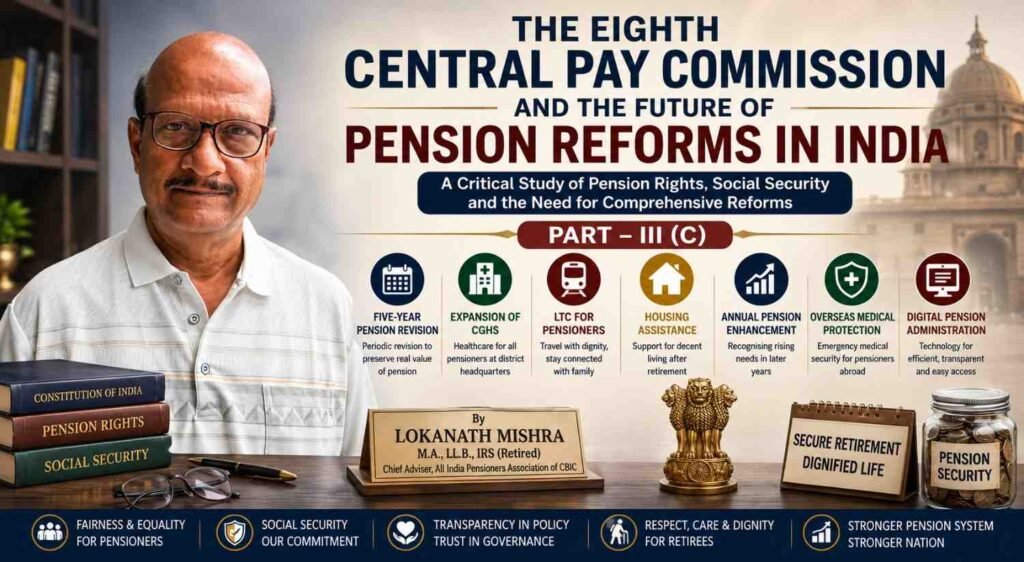
THE EIGHTH CENTRAL PAY COMMISSION AND THE FUTURE OF PENSION REFORMS IN INDIA:
By Lokanath Mishra M.A., LL.B., IRS (Retired)
A Critical Study of Pension Rights, Social Security and the Need for Comprehensive Reforms:
PART–III (C )
Chapter–14
Recommendations of Parliamentary Committees and Emerging Issues in Pension Policy: A Framework for the Eighth Central Pay Commission:
Introduction
The recommendations of Parliamentary Committees deserve serious attention while formulating pension policy. Although such recommendations do not automatically become law, they reflect the considered views of Members of Parliament after examining evidence from Ministries, experts, employee organisations and pensioners’ associations. Consequently, they constitute valuable policy inputs for the Government and the Eighth Central Pay Commission.
Several pensioners’ organisations, including the All India Pensioners Association of the Central Board of Indirect Taxes and Customs (CBIC), have urged that recommendations relating to periodic pension revision, expansion of medical facilities and removal of pension anomalies should be examined and implemented wherever considered appropriate.
The objective should be to establish a pension system that protects the dignity of retired public servants while remaining administratively efficient and fiscally sustainable.
Periodic Revision of Pension Every Five Years:
One of the most significant proposals emerging from pensioners’ organisations is that pension should not remain static for nearly a decade until the next Central Pay Commission.
The existing system generally relies upon Dearness Relief to offset inflation. While Dearness Relief provides substantial protection against the erosion of purchasing power, it cannot by itself address structural changes in the economy, healthcare costs and the increasing financial needs associated with advancing age.
Medical inflation often exceeds general inflation. Expenditure on medicines, specialised treatment, long-term care and diagnostic procedures increases substantially after retirement. Consequently, pensioners frequently experience a gradual decline in their standard of living despite regular Dearness Relief.
The Government may therefore examine whether a structured review of pensions at intervals of approximately five years would provide a more responsive mechanism for maintaining the adequacy of retirement income. Such a review need not necessarily involve the constitution of a new Pay Commission. It may instead be undertaken through a statutory review mechanism operating under principles prescribed by the Government.
Periodic revision would also reduce the need for major adjustments after long intervals and may contribute to greater predictability in public expenditure.
Expansion of CGHS to All District Headquarters:
Healthcare constitutes the most important social security requirement for elderly pensioners.
At present, Central Government Health Scheme (CGHS) facilities are concentrated in selected cities. A large number of pensioners reside in districts where comprehensive CGHS services are unavailable.
Many Parliamentary Committees and pensioners’ organisations have highlighted the need for expanding healthcare facilities so that pensioners are not required to travel long distances merely to obtain consultation, medicines or referrals.
The Government may therefore examine a phased expansion of CGHS Wellness Centres based upon objective criteria such as the concentration of beneficiaries, existing medical infrastructure, accessibility and financial feasibility.
Such expansion would reduce hardship, improve preventive healthcare and strengthen confidence among retired employees.
Leave Travel Concession (LTC) for Pensioners:
At present, Leave Travel Concession is primarily a service benefit available during active employment.
However, retirement does not diminish the social and emotional importance of travel. Many elderly pensioners wish to visit their children, grandchildren, places of pilgrimage, historical monuments and cultural centres.
Travel also contributes to physical and psychological well-being by encouraging social interaction and active ageing.
Recognising these considerations, the Eighth Central Pay Commission may examine whether a modified travel concession could be introduced for pensioners.
Possible options include:
- concessionary railway travel through coordination with the Ministry of Railways;
- limited air travel concession under specified conditions;
- reimbursement for one journey within a prescribed period;
- special concessions for pensioners above a specified age.
Such proposals would require detailed financial examination but deserve thoughtful consideration from the perspective of social welfare.
Housing Assistance After Retirement:
House Rent Allowance is designed to compensate serving employees for expenditure on rented accommodation.
Ordinarily, HRA ceases upon retirement because pension replaces salary.
Nevertheless, housing remains one of the largest recurring expenditures for many retired employees, particularly those residing in metropolitan cities or those who do not own residential property.
Rather than extending HRA in its present form, the Government may examine alternative measures such as:
- housing assistance for economically weaker pensioners;
- subsidised accommodation for very senior pensioners in exceptional circumstances;
- concessional housing schemes developed in collaboration with public sector housing agencies.
Such measures may provide targeted assistance while preserving the original purpose of HRA as a service allowance.
Annual Pension Enhancement:
Serving employees receive annual increments recognising continued service and increasing experience.
Pensioners, by contrast, no longer receive increments despite the fact that their financial requirements generally increase with advancing age.
The Eighth Central Pay Commission may therefore study whether an appropriate mechanism for modest periodic pension enhancement could be devised, independent of Dearness Relief, to recognise the increasing expenditure associated with ageing.
Possible approaches may include:
- a fixed percentage enhancement after specified intervals;
- age-linked increases commencing earlier than the existing additional pension provisions;
- periodic pension adjustment linked to objective economic indicators.
Any recommendation in this regard would naturally require careful assessment of fiscal implications.
Retrospective Promotion and Consequential Pension Revision:
Numerous employees have retired during the pendency of disputes relating to promotion, seniority or recruitment.
In several cases, courts have subsequently recognised their entitlement to promotion or directed reconsideration by the competent authorities.
Where promotion is ultimately granted with retrospective effect in accordance with applicable service rules or judicial directions, the consequential revision of pension and retirement benefits assumes considerable importance.
The Government may consider establishing a time-bound mechanism to ensure prompt implementation of such decisions so that retired employees are not compelled to engage in prolonged litigation for consequential pensionary benefits.
Such a system would promote administrative efficiency and reduce avoidable legal disputes.
Overseas Emergency Medical Protection:
Globalisation has resulted in a growing number of retired Central Government employees whose children have settled abroad.
Many pensioners periodically travel overseas to spend time with their families.
Medical emergencies occurring during such visits often impose severe financial burdens because existing Government healthcare arrangements are principally designed for treatment within India.
The Eighth Central Pay Commission may therefore examine the feasibility of a Government-supported overseas emergency medical insurance or reimbursement mechanism for pensioners travelling abroad, subject to clearly defined eligibility conditions, financial ceilings and safeguards against misuse.
Such a proposal would recognise changing family patterns while ensuring that elderly pensioners are not exposed to catastrophic medical expenditure during temporary visits overseas.
Digital Pension Administration:
India has made remarkable progress in digital governance.
The next phase of pension reform should integrate technology to improve efficiency and transparency.
The Government may consider:
- a unified national digital pension portal;
- real-time pension status tracking;
- online grievance redressal;
- electronic updating of pension records;
- integration of CGHS, pension disbursement and life certificate systems.
Digital administration would reduce delays, improve accountability and enhance convenience for pensioners residing both within India and abroad.
Conclusion
The future of pension policy extends beyond revision of pay and pension. It encompasses healthcare, social security, dignity, administrative efficiency and technological modernisation.
The issues discussed in this chapter do not merely represent financial demands. They reflect broader questions concerning the relationship between the State and those who have devoted decades of service to the nation.
The Eighth Central Pay Commission has a unique opportunity to recommend a pension framework that is equitable, compassionate, transparent and financially responsible. A balanced approach that carefully evaluates these proposals in the light of constitutional principles, demographic realities and fiscal sustainability would strengthen India’s commitment to the welfare of its retired public servants.
(The final part of this research paper will present an Editorial Summary, a proposed “Pensioners’ Bill of Rights”, comprehensive recommendations to the Eighth Central Pay Commission and concluding observations.)