
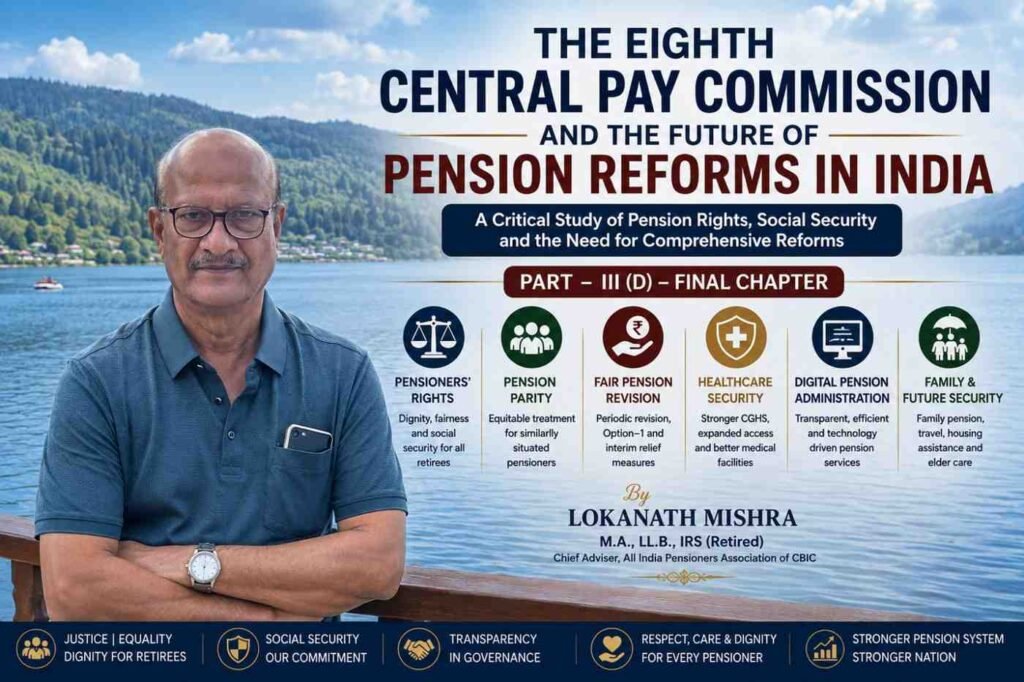
THE EIGHTH CENTRAL PAY COMMISSION AND THE FUTURE OF PENSION REFORMS IN INDIA:
By Lokanath Mishra M.A., LL.B., IRS (Retired)
A Critical Study of Pension Rights, Social Security and the Need for Comprehensive Reforms
PART–III (D)
FINAL CHAPTER
Editorial Summary, Recommendations to the Eighth Central Pay Commission and the Future of Pension Reforms in India:
Editorial Summary:
The establishment of the Eighth Central Pay Commission provides an opportunity to undertake one of the most comprehensive reviews of the service conditions and retirement benefits of Central Government employees since Independence. While revision of pay has traditionally received greater public attention, the concerns of pensioners deserve equal consideration because retirement does not terminate the relationship between the State and those who have devoted decades of their lives to public service.
The analysis presented in this research paper demonstrates that pension policy is no longer merely an issue of financial calculation. It is closely connected with constitutional values, demographic change, healthcare needs, administrative efficiency and social justice.
The Supreme Court of India has consistently recognised pension as an important service benefit earned through long years of dedicated service. Equally, the Constitution envisages a welfare State committed to securing dignity and social security for elderly citizens.
The demands placed before the Government by the All India Pensioners Association of the Central Board of Indirect Taxes and Customs (CBIC) and other recognised pensioners’ organisations reflect genuine concerns arising from changing economic conditions, increasing life expectancy, rising healthcare costs and persistent anomalies in pension administration.
Although every proposal requires careful financial examination, these issues deserve objective and time-bound consideration by the Government and the Eighth Central Pay Commission.
A Proposed Pensioners’ Bill of Rights:
The following principles may serve as guiding values for future pension reforms:
Right to Dignity:
Every retired Government servant has the right to live with dignity, independence and financial security after retirement.
Right to Fair Pension Revision:
Pension should be revised periodically through a transparent and equitable mechanism so that its real value is not substantially eroded over time.
Right to Pension Parity:
Similarly situated pensioners should receive equitable treatment consistent with applicable statutory rules and constitutional principles.
Right to Affordable Healthcare:
Every pensioner should have access to quality, affordable and timely medical treatment through an efficient Government-supported healthcare system.
Right to Timely Implementation of Judicial Decisions:
Judicial decisions having general applicability should be examined promptly by the Government so that avoidable litigation by similarly placed employees and pensioners is minimised, consistent with the applicable law.
Right to Transparent Pension Administration:
Pension sanction, revision and payment should be governed by transparent procedures supported by modern digital technology.
Right to Speedy Grievance Redressal:
Every pensioner should have access to an efficient, accountable and time-bound grievance redressal mechanism.
Right to Family Security:
Family pension policies should continue to provide meaningful social security while reflecting changing social realities and the objectives of the pension system.
Right to Digital Accessibility:
Pensioners should be able to access pension-related services electronically without unnecessary procedural difficulties.
Right to Respect:
Retired public servants should continue to receive recognition and respect for their contribution to nation-building.
Recommendations for Consideration by the Eighth Central Pay Commission:
In light of the foregoing discussion, the following recommendations merit careful examination:
Pension Revision
A fair and equitable methodology should be evolved for revision of pension for all existing pensioners whenever a new Pay Commission is implemented.
Examination of Option–1:
The Commission may undertake a comprehensive evaluation of the methodology examined under Option–1 of the Seventh Central Pay Commission to determine whether an updated notional pay-based approach can reduce disparities among similarly placed pensioners while remaining fiscally sustainable.
Periodic Pension Review:
Instead of relying solely upon decennial Pay Commissions, the Government may examine the feasibility of reviewing pension at intervals of approximately five years through an institutional mechanism.
Dearness Relief:
Dearness Relief should continue as protection against inflation while periodic revision of basic pension should address structural increases in the cost of living.
Interim Relief:
Where implementation of a Pay Commission is substantially delayed, the Government may examine whether interim financial relief is appropriate, taking into account fiscal conditions.
Healthcare Reform:
CGHS should continue to be strengthened through phased expansion, wider empanelment of hospitals, improved availability of medicines, greater use of digital systems and simplified procedures.
Digital Pension Administration:
An integrated national digital pension platform may be developed to facilitate pension revision, grievance redressal, life certificates and medical benefits.
Career Progression:
Timely Departmental Promotion Committees and efficient cadre management should be encouraged so that avoidable pension disputes are minimised.
Retrospective Promotion:
Where promotions are granted retrospectively in accordance with law, consequential pension revision should be processed expeditiously.
Emerging Welfare Measures:
The Commission may also examine the feasibility of introducing or strengthening policy measures relating to:
- periodic travel concessions for pensioners;
- targeted housing assistance for economically vulnerable retirees;
- structured pension enhancement mechanisms reflecting advancing age;
- emergency medical protection during temporary overseas visits;
- simplified family pension administration.
Each proposal should be evaluated on its legal merits, social objectives and financial implications.
Long-term Pension Architecture:
The Government may undertake a comprehensive review of the long-term operation of the Old Pension Scheme (OPS), the National Pension System (NPS) and the Unified Pension Scheme (UPS), including whether aspects of these systems can be harmonised to achieve greater equity, retirement security, administrative simplicity and fiscal sustainability.
The Road Ahead
India is entering a period in which the proportion of elderly citizens will continue to increase.
Future pension policy must therefore extend beyond periodic revision of pay and pension. It should evolve into a comprehensive framework encompassing healthcare, digital governance, social security, financial sustainability and human dignity.
The objective should not merely be to increase expenditure but to ensure that public resources are utilised efficiently to provide meaningful protection to retired employees.
The Eighth Central Pay Commission has an historic opportunity to modernise India’s pension system in a manner that balances the legitimate expectations of employees and pensioners with the financial responsibilities of the State.
Conclusion:
The true strength of a nation is measured not only by the opportunities it offers to those who are in service, but also by the dignity it preserves for those who have completed a lifetime of public service.
A pension is neither a charity nor a gratuitous payment. It represents deferred compensation earned through years of dedication, integrity and commitment to the service of the Republic. As society evolves, pension policy must also evolve to reflect changing demographic realities, increasing longevity, advances in healthcare and the constitutional promise of social justice.
The Eighth Central Pay Commission therefore has a unique opportunity to recommend reforms that are equitable, compassionate, transparent and financially responsible. Its recommendations should seek to preserve the confidence of serving employees, ensure adequate retirement security for pensioners and strengthen public trust in Government institutions.
Ultimately, pension reform is not merely about revising figures in a pay matrix. It is about reaffirming the nation’s continuing commitment to those who have devoted the most productive years of their lives to the service of India. Any reforms adopted should strive to achieve a careful balance between the legitimate welfare expectations of pensioners and the long-term fiscal sustainability of the public exchequer. Such a balanced approach would uphold the constitutional ideals of equality, dignity and social justice while contributing to an efficient and humane system of public administration for generations to come.
Very good analysis.