
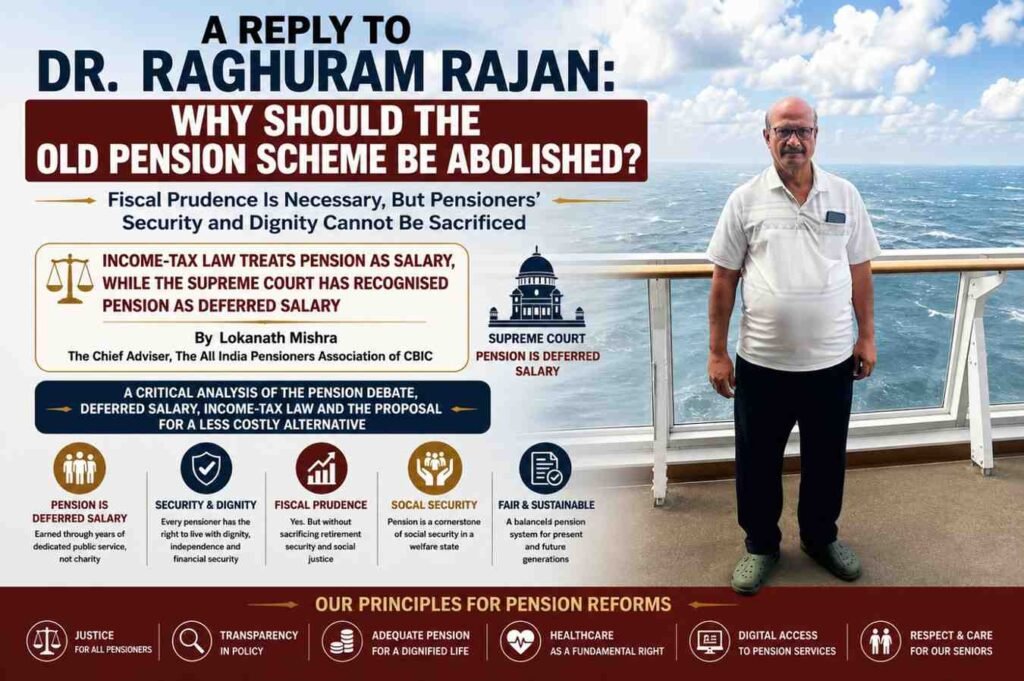
A REPLY TO DR. RAGHURAM RAJAN: WHY SHOULD THE OLD PENSION SCHEME BE ABOLISHED ?
By Lokanath Mishra, The Chief Adviser, The All India Pensioners Association of CBIC:
Fiscal Prudence Is Necessary, But Pensioners’ Security and Dignity Cannot Be Sacrificed:
Income-tax Law Treats Pension as Salary, While the Supreme Court Has Recognised Pension as Deferred Salary:
A Critical Analysis of the Pension Debate, Deferred Salary, Income-Tax Law and the Proposal for a Less Costly Alternative
Abstract
The debate concerning the Old Pension Scheme (OPS), the National Pension System (NPS) and the Unified Pension Scheme (UPS) has assumed considerable importance in India. The principal criticism of OPS is that it creates a long-term fiscal liability for the Government. Former RBI Governor Dr. Raghuram Rajan has argued that instead of simply restoring OPS, governments should explore less costly alternatives that provide retirement security while limiting the fiscal burden.
The concern regarding fiscal sustainability is legitimate and deserves careful consideration. However, pension policy cannot be assessed exclusively as an item of Government expenditure. Pension is also a retirement benefit arising from public employment, a form of social security and, in judicial language, a form of deferred salary.
This article examines the pension question from four interconnected perspectives: constitutional jurisprudence, employment law, income-tax law and social security.
Particular attention is given to section 17(1) of the Income-tax Act, 1961, which expressly provides that, for the purposes of the provisions governing income from salary, the expression “salary” includes “any annuity or pension.” The Income Tax Department itself confirms that pension is included within the statutory concept of salary.
This statutory treatment, read with Supreme Court decisions describing pension as “deferred salary,” provides substantial support for the proposition that pension is not a mere bounty or gratuitous post-retirement payment. At the same time, tax classification alone does not establish that the Government literally deducted the pension amount from an employee’s monthly salary and kept it for payment after retirement. The more accurate legal proposition is that pension represents a deferred component of the overall remuneration and social-security relationship arising from Government service.
From this perspective, this article argues that, particularly for lower-income Government employees whose retirement security depends substantially upon pension, the defined-benefit principles underlying OPS remain highly relevant. Rather than transferring investment and longevity risks entirely or substantially to individual employees, India should seek a financially sustainable pension architecture that preserves certainty, inflation protection and dignity in old age.
- Introduction:
The pension question is often presented as a conflict between the financial interests of Government and the demands of employees.
That approach is too narrow.
The real issue is:
What does a democratic welfare State owe to a person who has devoted thirty or thirty-five years of his or her working life to public service?
An employee works throughout his or her economically productive years with the legitimate expectation that the conditions of service applicable to the employment will provide reasonable financial security after retirement.
Salary during service is therefore only one part of the economic relationship between the employee and the State.
Retirement benefits constitute another part of that relationship.
Pension is particularly important because, unlike many other retirement benefits, it is ordinarily paid periodically throughout the pensioner’s lifetime.
For government employee, pension may constitute the principal source of income after retirement.
Consequently, pension reform should not be designed solely around the question:
“How much will the Government save?”
It should also ask:
“How much retirement security will the employee lose?”
- The Central Argument:
The central argument of this article is straightforward.
Pension is not charity.
It is not a voluntary payment made by the Government merely because a former employee has become old.
It arises from the employment relationship and from statutory pension rules governing Government service.
Indian courts have repeatedly described pension as a right and, in appropriate contexts, as deferred salary.
The Supreme Court has expressly referred to pension as deferred salary in cases including State of Tamil Nadu v. Seshachalam and U.P. Raghavendra Acharya v. State of Karnataka. (Indian Kanoon)
The Income-tax Act provides an important additional perspective.
Section 17(1) of the Income-tax Act, 1961 states:
“salary” includes … “any annuity or pension.”
Thus, for income-tax purposes, pension is expressly brought within the statutory definition of salary.
This statutory treatment is highly significant.
- What Does the Income-tax Act Actually Say About Pension?
Section 17(1)(ii)
Section 17 of the Income-tax Act defines “salary”, “perquisite” and “profits in lieu of salary.”
Section 17(1) provides an inclusive definition of salary and expressly includes:
- wages;
- any annuity or pension;
- gratuity;
- fees and commissions;
- perquisites;
- profits in lieu of salary;
- advance salary; and
- specified other payments.
The official Income Tax Department’s guidance similarly states that section 17 includes pension within the definition of salary.
Therefore, pension is not treated under the Income-tax Act as an unrelated windfall.
It falls within the statutory concept of salary income.
- Why This Tax Treatment Is Significant:
The significance of section 17 goes beyond the mere question of taxation.
The legislature has consciously used the word “includes”.
Thus, for the purposes of the salary provisions, pension is brought within the statutory concept of salary even though the payment is received after retirement.
This produces an important conceptual distinction.
During service:
Employee → renders service → receives salary.
After retirement:
Former employee → receives pension arising from the previous employment relationship.
The tax statute recognises sufficient continuity between the employment relationship and pension to place pension within the statutory category of salary.
The Income Tax Department expressly notes that pension is included in salary and that tax deduction provisions can apply to pension.
This is powerful evidence that pension should not be viewed simply as an ex-gratia payment.
- Does the Income-tax Act Prove That Pension Was Literally Deducted From Salary?
This proposition requires careful treatment.
It would be legally incorrect to say:
“Because pension is taxed as salary, the Income-tax Act proves that the Government deducted the pension from the employee’s salary every month and returned the same money after retirement.”
The Income-tax Act does not establish such an accounting mechanism.
There is an important distinction between:
Tax classification
and
Actual funding mechanism.
Section 17 tells us how pension is treated for income-tax purposes.
It does not say that an identical amount was physically withheld from each month’s salary and deposited into an individual pension account.
Therefore, a journal article should not make that absolute claim.
The stronger and legally sustainable proposition is:
Pension is treated by Parliament, for income-tax purposes, as falling within the statutory concept of salary; and the Supreme Court has repeatedly described pension, in the context of Government service, as deferred salary. Therefore, pension has a substantial legal and conceptual connection with the remuneration arising from public employment and cannot properly be characterised as a mere gratuitous payment.
That proposition is considerably stronger because it rests on both legislation and judicial reasoning.
- Pension as Deferred Salary: Judicial Recognition:
The Supreme Court has used the expression “deferred salary” in relation to pension.
In State of Tamil Nadu v. Seshachalam, the Court referred to the principle that pension is not a bounty but deferred salary. (Indian Kanoon)
Similarly, in U.P. Raghavendra Acharya v. State of Karnataka, the Supreme Court observed that pension is not a bounty and is treated as deferred salary, akin to a property right. (Indian Kanoon)
These observations are important because they establish the conceptual basis of the pension argument.
The employee does not suddenly become entitled to pension because the Government wishes to make a charitable payment.
Rather, pension arises because of the employee’s completed service and the legal framework governing that service.
- Article 300-A and the Property Dimension of Pension:
The legal character of pension has also been considered in the context of the constitutional protection of property.
Article 300-A provides that no person shall be deprived of property except by authority of law.
Indian judicial decisions have recognised pensionary entitlements as having a property dimension.
The Andhra Pradesh High Court, considering Supreme Court jurisprudence concerning salary and pension, has observed that salary and pension fall within the concept of property for Article 300-A purposes and that pension is intended to provide livelihood after retirement. (Indian Kanoon)
This reinforces an important principle:
A pensioner is not a recipient of charity. The pensioner possesses a legally recognised retirement entitlement governed by law.
- The Importance of D.S. Nakara
The constitutional dimension of pension was dramatically strengthened by the Supreme Court’s judgment in D.S. Nakara v. Union of India.
The judgment treated pension as a social-welfare measure and emphasised equality among similarly situated pensioners.
Although Nakara should not be interpreted as freezing India’s pension system permanently in one particular form, its underlying constitutional philosophy remains relevant.
The State possesses power to reform pension systems.
But pension reform must remain consistent with constitutional principles and should not arbitrarily discriminate between similarly situated persons.
- Deferred Salary Does Not Mean a Literal Monthly Deduction:
This distinction deserves emphasis because it will strengthen the credibility of the pensioners’ argument.
Suppose an employee receives ₹35,000 as monthly salary.
It would not necessarily follow that the Government withheld ₹5,000 every month specifically as “pension money.”
Under a defined-benefit pension system, the pension is determined according to statutory rules based upon factors such as qualifying service and emoluments.
The pension system is therefore fundamentally different from an individual savings account.
Nevertheless, the employee’s pension entitlement is generated by the service relationship.
Thus:
Deferred salary does not necessarily mean deferred cash deposited in an individual account.
It means that part of the economic reward attached to public employment becomes payable after retirement according to the pension rules.
This is the more accurate legal and economic understanding.
- Why This Distinction Matters in the OPS Debate:
If pension is understood merely as an expenditure incurred after retirement, it becomes easy to argue:
“The employee has already received salary. Why should Government continue paying?”
But if pension is understood as part of the overall employment and retirement-security arrangement, the question becomes different:
“What retirement benefit did the employee earn through his or her qualifying service under the applicable service conditions?”
This is the appropriate question.
- OPS and the Principle of Defined Benefit:
The fundamental strength of OPS is that it provides a defined-benefit framework.
The pension is determined according to statutory rules rather than depending primarily upon the accumulated value of an individual’s investment corpus.
This protects the employee against:
- investment volatility;
- poor market performance;
- inadequate annuity rates;
- unexpectedly long life;
- inflation; and
- uncertainty regarding future income.
For a lower-income employee, these protections are extremely important.
- NPS Changes the Distribution of Risk:
The principal difference between a defined-benefit pension and a defined-contribution system is not simply the method of calculation.
It is the distribution of risk.
Under a defined-benefit system, the State assumes a greater share of:
longevity risk + investment risk + pension adequacy risk.
Under a defined-contribution system, the employee bears a larger share of those risks.
This may be appropriate for individuals possessing substantial alternative assets.
But it can be problematic for employees whose pension represents their principal retirement income.
- Why Lower-Paid Employees Require Greater Protection:
Consider two hypothetical retirees.
Retiree A
Has:
- a house;
- agricultural land;
- bank deposits;
- shares;
- rental income; and
- family wealth.
Retiree B
Has:
- a modest pension;
- no significant property;
- no substantial investment portfolio;
- substantial medical expenditure.
Both may have completed identical periods of Government service.
But their capacity to bear pension-market risk is completely different.
For Retiree A, a fall in investment returns may be inconvenient.
For Retiree B, it may mean inability to purchase medicines.
Pension policy must therefore consider capacity to bear risk, not merely theoretical investment returns.
- Inflation and Dearness Relief:
The principal weakness of a pension without adequate inflation protection is the gradual erosion of purchasing power.
Suppose a pensioner receives ₹30,000 per month.
If the cost of essential goods rises substantially over ten years, the nominal ₹30,000 will purchase considerably less.
The traditional pension system’s provision of Dearness Relief provides a mechanism for addressing inflation.
An alternative system must provide comparable protection.
Otherwise, a pension that appears adequate at retirement may become inadequate during advanced old age.
- Healthcare Inflation
Healthcare is perhaps the strongest reason for protecting pension adequacy.
As people grow older, medical expenditure generally becomes more important.
A pensioner may require:
- medicines;
- diagnostic investigations;
- specialist consultations;
- hospitalisation;
- physiotherapy;
- dental treatment;
- optical treatment;
- nutritional supplements; and
- emergency treatment.
Government healthcare systems such as CGHS provide important protection, but they cannot necessarily eliminate every expenditure.
Therefore, the pension must retain sufficient purchasing power to meet expenses outside the Government healthcare framework.
- The Rising Cost of Ordinary Life:
Pensioners do not spend money only on food and medicines.
They must also meet:
- transport expenses;
- electricity;
- telephone and internet charges;
- household maintenance;
- clothing;
- domestic assistance;
- religious activities;
- family functions;
- travel;
- social obligations; and
- assistance to children or grandchildren where necessary.
As prices rise, a fixed pension becomes increasingly inadequate.
Therefore, pension revision should not be viewed as an optional generosity.
It is necessary to preserve the real value of retirement income.
- Pension and Income Tax: A Significant Irony:
There is an important policy irony here.
During service, the employee pays income tax on taxable salary.
After retirement, the pension arising from that employment is again brought within the statutory definition of salary for income-tax purposes and may be taxable subject to applicable exemptions, deductions and prevailing tax provisions.
The official Income Tax Department expressly states that pension forms part of salary income under section 17.
This demonstrates that the tax law treats pension as an income stream sufficiently connected with employment to be classified as salary.
The pensioner therefore continues to have a fiscal relationship with the State even after retirement.
- Pension Is Not a Free Gift:
If pension were simply a charitable payment, there would be no conceptual reason to describe it as salary for tax purposes or to repeatedly characterise it judicially as deferred salary.
The stronger proposition is:
Pension is a statutory retirement entitlement arising from public service, possessing characteristics of deferred remuneration and social security.
The fact that its financing is undertaken through the Government’s budget does not convert the pension into charity.
- The Fiscal Objection Remains Valid:
The pensioners’ argument should not ignore the Government’s fiscal responsibility.
OPS creates long-term liabilities.
Increasing life expectancy means that pensions may be paid for longer periods.
The number of pensioners may increase relative to the number of serving employees.
Therefore, actuarial projections are necessary.
The correct response, however, is not necessarily abolition.
It is fiscal management.
- Fiscal Sustainability Can Coexist with Defined Benefits:
A sustainable defined-benefit pension system can be developed through:
- actuarial valuation;
- transparent pension accounting;
- periodic review;
- appropriate pension ceilings where justified;
- rational retirement-benefit structures;
- improved tax collection;
- better management of public expenditure;
- creation of pension reserves; and
- demographic forecasting.
Thus, the choice need not be:
OPS OR fiscal discipline.
It can be:
OPS principles + fiscal discipline.
- The Argument of Inter-Generational Equity
Critics argue that today’s taxpayers should not finance tomorrow’s pensions.
That concern is legitimate.
But today’s employees are also tomorrow’s pensioners.
The State must therefore create a system that balances:
current taxpayers + serving employees + future pensioners.
Inter-generational equity cannot mean making future pensioners economically insecure.
It should mean establishing a system that is sustainable across generations.
- The Question of Employee Contribution
NPS and other contribution-based systems require employee contributions.
For lower-paid employees, the deduction reduces disposable income during working life.
This creates an important policy trade-off:
Lower income today in exchange for uncertain income tomorrow.
A defined-benefit system provides greater certainty about the second component.
The State must therefore decide how much retirement risk should reasonably be imposed upon an employee.
⸻
- Market Risk and the Elderly
Investment markets can generate substantial long-term returns.
But market returns are uncertain.
A person retiring during a severe market downturn may suffer consequences that cannot easily be reversed.
The employee cannot postpone old age.
The employee cannot postpone medical expenditure.
The employee cannot postpone the need to purchase food.
Therefore, retirement security requires a protected income floor.
⸻
- UPS and the Search for a Middle Path
UPS attempts to provide greater certainty than a purely market-linked pension.
This recognition is significant.
It demonstrates that policymakers themselves recognise the importance of pension predictability.
The appropriate question is therefore not whether certainty is necessary.
The question is:
How much certainty should the pension system guarantee?
From the perspective of lower-income Government employees, a stronger defined-benefit component remains preferable.
⸻
- The Case for Restoring OPS
The case for OPS can therefore be summarised as follows:
First:
Pension is legally connected with public employment.
Second:
The Supreme Court has described pension as deferred salary.
Third:
The Income-tax Act expressly includes pension within “salary.”
Fourth:
Pension is a recognised social-security instrument.
Fifth:
Lower-income employees have limited capacity to bear investment risk.
Sixth:
Healthcare expenditure increases with age.
Seventh:
Inflation progressively erodes fixed income.
Eighth:
A defined-benefit system protects against longevity risk.
Ninth:
Pension provides dignity and independence in old age.
Tenth:
Fiscal concerns can be addressed through actuarial and financial reforms without necessarily abandoning defined benefits.
⸻
- What Should Be Done Instead of Abolishing OPS?
The Government should consider the following approach:
- Restore a defined-benefit pension framework
Particularly for employees whose retirement security depends predominantly upon Government pension.
- Protect existing pensioners
No reform should undermine legitimate pensionary entitlements already earned.
- Provide inflation protection
Dearness Relief should continue to preserve purchasing power.
- Revise pension periodically
A five-year structural pension review should be considered.
- Strengthen healthcare
CGHS should be expanded and improved.
- Establish actuarial discipline
Pension liabilities should be independently assessed.
- Improve Government revenue
Fiscal sustainability should be supported by stronger revenue mobilisation.
- Maintain transparency
The Government should publish long-term pension liability projections.
⸻
- A More Accurate Formulation of the “Deferred Salary” Argument
The pensioners’ movement should therefore formulate its position carefully.
Instead of saying:
“The Government deducted the pension from our salary and is now returning it.”
the legally stronger formulation is:
“Pension is a deferred component of the overall remuneration and retirement-security relationship arising from Government service. The Supreme Court has described pension as deferred salary, while section 17(1) of the Income-tax Act expressly includes pension within the statutory definition of salary for the purposes of the income-tax provisions.”
This formulation is both powerful and legally defensible.
It avoids an assertion about the accounting mechanism that the Income-tax Act itself does not establish.
⸻
- A New Principle for Pension Policy
India should adopt the following principle:
No pension reform should reduce an elderly person’s retirement security merely to transfer fiscal risk from the Government to the pensioner.
If a pension system needs reform, the reform should address inefficiency, administration, funding and actuarial sustainability—not simply shift the burden to the weakest participant.
⸻
- Conclusion
The debate over OPS should not be reduced to a contest between economists and employees.
Both fiscal sustainability and social security are legitimate public objectives.
Dr. Raghuram Rajan’s concern that pension liabilities must remain financially sustainable is therefore worthy of serious consideration.
But fiscal prudence should not be interpreted as an obligation to minimise pension expenditure at any social cost.
The Income-tax Act provides an important statutory perspective.
Section 17(1) expressly includes “any annuity or pension” within the definition of “salary.” The Income Tax Department itself confirms that pension is included in salary income. (Etds)
Judicial decisions have gone further and have described pension as deferred salary. (Indian Kanoon)
Taken together, these principles establish that pension has a deep and legally recognised connection with the employment relationship.
It would therefore be inappropriate to characterise pension merely as a gratuitous expenditure incurred by the State for former employees.
At the same time, it is equally important to recognise that the Income-tax Act’s classification of pension as salary does not, by itself, prove that a specific amount was physically deducted from each employee’s monthly salary and accumulated for later payment. The legally sound conclusion is that pension represents a statutory retirement entitlement arising from the employment relationship and possessing the characteristics of deferred remuneration and social security.
That distinction makes the pensioners’ argument stronger, not weaker.
The real question is therefore not:
“Can India afford to pay pensions?”
The real question is:
“How can India guarantee dignified retirement security while maintaining long-term fiscal sustainability?”
The answer should not automatically be the transfer of investment, longevity and inflation risks from the State to elderly pensioners.
A person who has served the Government for thirty or thirty-five years should not be required to become a financial-market expert merely to secure food and medicines in old age.
For the lower-paid Government employee, pension is not luxury.
It is the economic foundation of retirement.
It pays for food.
It pays for medicines.
It pays for transportation.
It contributes to housing and household expenses.
It permits participation in family, social, cultural and religious life.
It provides independence.
Above all, it provides dignity.
Therefore, the guiding principle of India’s pension policy should be:
A lifetime of public service must not end in economic insecurity.
OPS should consequently not be dismissed merely because it creates a fiscal liability. Instead, the Government should examine whether the defined-benefit principles of OPS can be preserved through actuarial discipline, transparent funding, periodic review, efficient expenditure and stronger revenue mobilisation.
The objective should be neither an unaffordable pension system nor an inadequate one.
The objective should be a pension system that is:
adequate, predictable, inflation-protected, socially just, legally secure and fiscally sustainable.
That is the standard by which every proposed pension reform should ultimately be judged.
Pension is not merely a payment made after service. It is the continuing recognition of a lifetime of service.
And if the law itself treats pension as salary for income-tax purposes, while the Supreme Court has described pension as deferred salary, then the State should approach pension reform not merely as an exercise in reducing expenditure, but as an exercise in preserving the dignity and economic security of those who served the Republic.
I am very much surprise to note your dedicated efforts to establish genuine claims. Thanks dear.
Hats off to Shri Loknath Mishra ji.
A fitting reply to the former RBI Governor n the great a fitting reply with Court judgements. Non of the office bearers of the retired association can reply the way Shri Mishra ji presented with legal backing with authority.
Thank you Sir for your dedication n leadership qualities. We are the CBIC retired officer are very fortunate to have you as the Chief Advisor. With regards. God bless you n your family 🙏🙏
What more need to be commented. I already posted my views in this regard.
I have already submitted n offered my views in this regard appritiating the efforts being made by Shri Loknath Mishra ji.
I already commented. There’s nothing to comment