
To
Hon’ble Shri Nitin Nabin, MP
National President, Bharatiya Janata Party
New Delhi
Subject: Humble request for your urgent intervention regarding prolonged administrative inaction, non-uniform implementation of Hon’ble High Court of Odisha orders concerning regularisation of leasehold land in Bhubaneswar, selective proposals for filing SLPs, and the proposed “Gen-Z Citizens’ Movement” for equal treatment, rule of law and welfare of affected citizens
Respected Sir,
I most respectfully submit this representation seeking your kind intervention in a matter which has assumed considerable importance for thousands of citizens and families of Bhubaneswar, particularly senior citizens, pensioners and retired persons who have been struggling for years to obtain lawful recognition and effective enjoyment of their leasehold properties.
The grievance relates principally to the prolonged and allegedly non-uniform implementation of the orders of the Hon’ble High Court of Odisha concerning regularisation of leasehold land, finalisation of Parchas, issuance of Pattas, correction of land Kissam to “Gharabari”, disposal of statutory OLR appeals and the reported proposal to challenge selected judgments of the Hon’ble High Court before the Hon’ble Supreme Court through SLPs.
I respectfully seek your intervention not for any individual favour, but for uniformity, transparency, accountability and equal treatment before law.
⸻
- The emerging “Gen-Z Citizens’ Movement” — why it has become necessary
Respected Sir, the expression “Gen-Z” is being used here as the name of a citizens’ platform and not merely in the conventional demographic sense of the term.
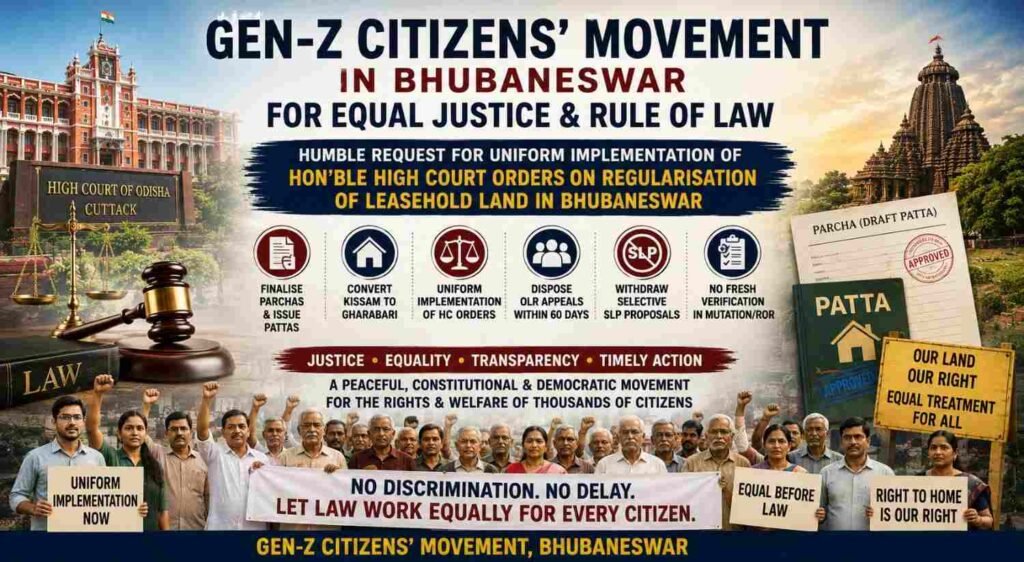
The proposed Gen-Z Citizens’ Movement in Bhubaneswar has emerged from prolonged frustration among citizens who have exhausted ordinary administrative channels and, in many cases, have spent years pursuing their grievances before the revenue authorities and constitutional courts.
The remarkable feature of this proposed movement is that its strength is not confined to young people.
A substantial number of those affected are senior citizens, retired employees and pensioners between approximately 40 and 80 years of age, who have been compelled to come forward because their lawful properties remain entangled in administrative and procedural difficulties.
Many of these citizens:
- lawfully acquired their properties;
- possess revenue records in their favour;
- have been granted Sthitiban status in appropriate cases;
- have paid Government rent;
- have approached courts when necessary;
- have obtained favourable judicial orders; and
- have waited for years for the corresponding administrative action.
Yet, despite all this, many remain unable to obtain building-plan approval and construct their own homes.
Some are consequently compelled to continue living in rented accommodation even during their old age, while their own land remains unavailable for effective residential use.
This situation has generated a profound sense of helplessness, frustration and loss of confidence in administrative responsiveness.
The proposed Gen-Z movement is therefore intended to provide a peaceful, constitutional and democratic platform through which affected citizens can collectively demand implementation of law and judicial orders.
It is not intended to target any individual officer or political party.
Its objective is simply:
“Equal treatment before law, uniform implementation of judicial orders, timely administrative justice and a permanent solution to the long-pending leasehold land problems of Bhubaneswar.”
⸻
- Concern regarding the present approach to land regularisation
It is respectfully submitted that, after assuming office, the present Government issued Revenue & Disaster Management Department Order No. RDM-CHS-PGOT-0303-2020-24868/R&DM dated 02.07.2025 concerning conversion of Sthitiban status into Patta-dar status.
The said decision generated considerable dissatisfaction among affected citizens, and several persons approached the courts and obtained favourable orders.
This has added another layer of uncertainty to an issue that has already remained unresolved for decades.
The fundamental concern of the citizens is that a Government policy relating to land rights should reduce litigation and uncertainty, rather than create additional litigation and uncertainty for ordinary citizens.
The people of Odisha expect a welfare-oriented administration to simplify land administration, remove unnecessary procedural barriers and provide certainty of title wherever citizens have established lawful rights.
Unfortunately, the continuing problems relating to leasehold land demonstrate the need for urgent corrective intervention and a coherent State-wide policy.
⸻
- Delay in finalisation of Draft Parchas
During settlement operations, Parchas—representing the draft recognition of land rights—were prepared and issued in a number of cases, including several cases in Pathargadia Mouza, Bhubaneswar.
Where no objection is filed within the prescribed period, including by the Government itself, citizens legitimately expect the settlement process to proceed to its logical conclusion and the corresponding Patta to be issued in accordance with law.
The legal position was considered by the Hon’ble High Court of Odisha in:
- Shakuntala Dash v. State of Odisha, W.P.(C) No. 11912/2017, and
- Padmanava Prusty v. State of Odisha, W.P.(C) No. 12776/2014.
The citizens understand that the State accepted the said judgments and did not prefer SLPs against them.
Yet, despite these judicial pronouncements, finalisation of several Parchas continues to remain pending.
This prolonged uncertainty has serious consequences.
A citizen who has gone through the settlement process should not be required to wait indefinitely for the administration to complete the very process initiated by the State itself.
A draft right cannot be kept in perpetual suspension when the statutory process has otherwise reached its logical stage.
Therefore, all eligible Parchas, particularly those against which no objection was filed within the prescribed period, deserve immediate examination and finalisation in accordance with law.
⸻
- Selective challenge to High Court judgments — serious concern regarding uniformity
Another issue causing considerable concern is the reported selective approach towards filing SLPs against judgments of the Hon’ble High Court.
Citizens have observed that in certain matters, favourable High Court orders have been implemented, while in some other apparently comparable matters proposals are reportedly being considered for approaching the Hon’ble Supreme Court.
The concern becomes particularly serious where:
- similarly situated citizens are involved;
- the same nature of leasehold land is involved;
- similar legal questions arise;
- one judgment is implemented without challenge; but
- another judgment dealing with substantially similar circumstances is sought to be challenged.
Such differential treatment naturally creates an impression among citizens that different standards may be applied to similarly situated persons.
The constitutional principle contained in Article 14 requires equality before law and protection against arbitrary State action.
I therefore respectfully request that the Government review all such cases comprehensively and formulate a consistent policy for deciding whether an SLP should be filed, rather than adopting a case-by-case approach that may result in apparent discrimination.
The ultimate objective should be to reduce unnecessary litigation and provide certainty to citizens.
⸻
- Non-conversion of “Baje Fasal” to “Gharabari” after grant of Sthitiban status
A particularly serious problem exists in cases where the Tahasildar, Bhubaneswar, has issued Patta and recorded the landholder’s status as “Sthitiban” pursuant to judicial orders, but the Kissam continues to remain recorded as “Baje Fasal” or agricultural land.
In other similarly situated cases, the Kissam has reportedly been changed to “Gharabari”.
This lack of uniformity creates a serious practical problem.
Where the land has been recognized as Sthitiban and the landholder has lawful rights, continued refusal to consider the appropriate Kissam conversion may prevent the citizen from obtaining approval for construction.
Consequently:
- building plans remain pending;
- citizens cannot construct their homes;
- retired persons continue to pay rent;
- property remains economically underutilised; and
- litigation continues unnecessarily.
The administration must therefore establish a clear, uniform and transparent procedure so that similarly situated citizens are treated alike.
⸻
- The human dimension — this is not merely a revenue-record dispute
The problem should not be viewed merely as a technical dispute concerning a revenue entry.
Behind every file there is a family.
Behind every Patta there is often a lifetime of savings.
Behind every pending Kissam conversion there may be an elderly person waiting to build the house in which he or she hopes to spend the remaining years of life.
Many citizens acquired their lands decades ago, when the surrounding areas were rural or semi-rural.
Bhubaneswar has subsequently expanded enormously.
Areas which were once agricultural have become part of the urban development area. Residential colonies, educational institutions, hospitals, commercial establishments and other urban infrastructure have developed around them.
Yet, in some cases, the revenue classification continues to create obstacles inconsistent with the present urban character and approved development planning of the area.
The result is a painful contradiction:
The city has moved forward, but the citizen’s land record remains trapped in the past.
This is precisely the type of administrative problem that requires a policy solution rather than endless individual litigation.
⸻
- Why a citizens’ movement has become unavoidable
For years, affected citizens have approached:
- Tahasildars;
- Settlement Authorities;
- District Administration;
- Revenue Authorities;
- the Revenue Board;
- the Hon’ble High Court; and
- in appropriate cases, the Hon’ble Supreme Court.
Despite this prolonged effort, a comprehensive solution has not emerged.
Ordinary citizens cannot be expected to spend the remainder of their lives moving between Government offices and courts.
Litigation is expensive.
Litigation is time-consuming.
And for senior citizens, prolonged litigation can be physically and emotionally exhausting.
Therefore, the proposed Gen-Z Citizens’ Movement is an expression of democratic frustration arising from the absence of a satisfactory administrative solution.
The movement will remain:
Peaceful.
Non-violent.
Constitutional.
Democratic.
Law-abiding.
It will not be directed against any individual.
It will not promote hatred or confrontation.
It will not interfere with public order.
Its only objective will be to draw the attention of the Government and the public to a long-pending administrative problem and demand a lawful solution.
The citizens strongly believe that peaceful democratic expression is preferable to continued silent suffering.
⸻
- Specific issues requiring your intervention
In view of the above, I respectfully request your good office to kindly take up the following issues with the Hon’ble Chief Minister and the concerned authorities:
(a) Uniform implementation of High Court judgments
All judgments of the Hon’ble High Court relating to leasehold land regularisation may be implemented uniformly, subject to the legal status of each case and any subsisting stay or other lawful impediment.
(b) Finalisation of Parchas
All Parchas issued during settlement operations, particularly where no objection was filed within the prescribed period, may be examined and finalised expeditiously in accordance with law.
(c) Uniform conversion to “Gharabari”
Where Sthitiban status has been lawfully granted and the legal conditions for conversion are satisfied, Kissam may be considered for conversion to “Gharabari” on a uniform basis.
(d) Time-bound disposal of OLR appeals
Pending OLR appeals before the ADM, Bhubaneswar, may be disposed of within a fixed time frame, preferably within 60 days, subject to the nature of each case and applicable law.
(e) Review of selective SLP proposals
The Revenue Department may undertake a comprehensive review of proposals for filing SLPs so that similarly situated cases are not subjected to inconsistent treatment.
Where there is no legally sustainable ground for further challenge, unnecessary litigation may be avoided.
(f) Avoidance of repetitive physical verification
In mutation and RoR correction matters, where physical verification has already been duly conducted by the Settlement Amin and the relevant records are available, unnecessary repetition of the same exercise may be avoided, subject to law.
(g) Issuance of Pattas on eligible Parchas
The Tahasildar, Bhubaneswar, may be directed to examine and process eligible Parchas issued during the settlement operation in Pathargadia Mouza, and issue Pattas wherever legally permissible.
⸻
- Why your intervention is particularly requested
I am approaching you with the sincere belief that a matter involving thousands of citizens should not remain confined to individual files.
The problem requires political attention at the appropriate level and administrative resolution at the competent level.
Your intervention can help ensure that the concerned authorities examine the entire issue objectively and develop a uniform approach.
The citizens are not asking the Government to ignore the law.
On the contrary, they are asking the Government to follow the law uniformly.
They are not asking for special treatment.
They are asking for equal treatment.
They are not asking the Government to bypass judicial orders.
They are asking that judicial orders be implemented faithfully and consistently.
They are not asking the Government to surrender its right to approach the Supreme Court.
They are asking that the decision to pursue further litigation be based upon a consistent legal policy rather than an apparently selective approach.
⸻
- The larger principle at stake
The issue ultimately concerns a simple democratic principle:
A citizen should not have to fight for decades to obtain from the administration what the law and judicial orders have already recognized.
The credibility of governance is measured not merely by the announcement of policies but by their implementation at the ground level.
For an elderly citizen, a pending land file is not merely a pending file.
It may represent:
- his lifetime savings;
- his family’s security;
- his retirement home;
- his financial stability; and
- his dignity in old age.
The Government therefore has a profound responsibility to ensure that administrative procedures do not become an endless source of hardship.
⸻
HUMBLE PRAYER
In view of the facts and circumstances stated above, I most respectfully request your good office to kindly intervene and take up the matter with the Hon’ble Chief Minister of Odisha and the concerned authorities for:
- Uniform and time-bound implementation of all applicable judgments of the Hon’ble High Court of Odisha concerning regularisation of leasehold land;
- Expeditious finalisation of eligible Parchas issued during settlement operations where no objection was filed within the prescribed period;
- Uniform consideration of conversion of Kissam to “Gharabari” in eligible Sthitiban cases;
- Direction to the ADM, Bhubaneswar, to dispose of pending OLR appeals within a fixed time frame, preferably within 60 days, subject to law;
- Review and withdrawal, wherever legally appropriate, of selective proposals for filing SLPs in matters involving substantially similar questions;
- Avoidance of unnecessary repeated physical verification where the Settlement Authorities have already conducted the requisite verification;
- Direction to the Tahasildar, Bhubaneswar, to examine and issue Pattas in eligible cases based upon Parchas issued during the settlement operation in Pathargadia Mouza;
- Formulation of a comprehensive and permanent policy/SOP for resolving the decades-old leasehold land problems in Bhubaneswar and other similarly affected areas of Odisha.
⸻
AN APPEAL BEFORE THE MATTER BECOMES A MASS MOVEMENT
Respected Sir,
The citizens who are preparing to participate in the Gen-Z Citizens’ Movement are not seeking confrontation with the Government.
They are seeking a response from the Government.
They have waited.
They have approached offices.
They have submitted representations.
They have approached courts.
They have complied with legal procedures.
They have paid Government revenue.
They have spent their savings on litigation.
Many have grown old while waiting for a solution.
They now wish to be heard collectively.
We sincerely hope that the Government will recognise the seriousness of their grievance and take concrete steps before the proposed citizens’ movement assumes a larger public dimension.
If timely and meaningful action is taken, the proposed movement can instead become an opportunity for the Government to demonstrate that citizens’ grievances can be resolved through dialogue, transparency, administrative reform and the rule of law.
I therefore earnestly appeal to you to kindly extend your good offices for an early meeting with representatives of the affected citizens and to place the matter before the Hon’ble Chief Minister and the concerned authorities for a time-bound, transparent and permanent solution.
The citizens have only one expectation:
“No discrimination. No selective implementation. No unnecessary delay. No endless litigation. Let the law operate equally for every citizen.”
I shall remain deeply grateful for your kind intervention in this matter concerning the dignity, shelter, property rights and future security of thousands of affected citizens of Bhubaneswar.
With profound respect and gratitude,
Yours faithfully,
LOKANATH MISHRA
Bhubaneswar, Odisha
Mobile: 9437314941
Email: jailoknathjee@gmail.com
Date: 21.08.2026
Copy forwarded for kind information and necessary action to:
- The Hon’ble Chief Minister of Odisha, Secretariat, Bhubaneswar – 751001.
- The Hon’ble Revenue Minister, Government of Odisha.
- Smt. Aparajita Sarangi, Hon’ble MP.
- Shri Baijayant Panda, Hon’ble MP.
- Shri Dharmendra Pradhan, Hon’ble MP.
Since we have owned the land for more than 30 years and have faced numerous obstacles brought about by the government’s anti-people policies, this will not be in our best interests. And this is the only money we make. Following years of court proceedings, the ruling ultimately favored the citizens. The current administration is still refusing to follow the ruling; instead, they wish to postpone it and provide additional ambiguity.