
When the Ganga Meets the Thames:
A Night of Light, Faith and Heritage in London:
By Lokanath Mishra IRS ( retired)
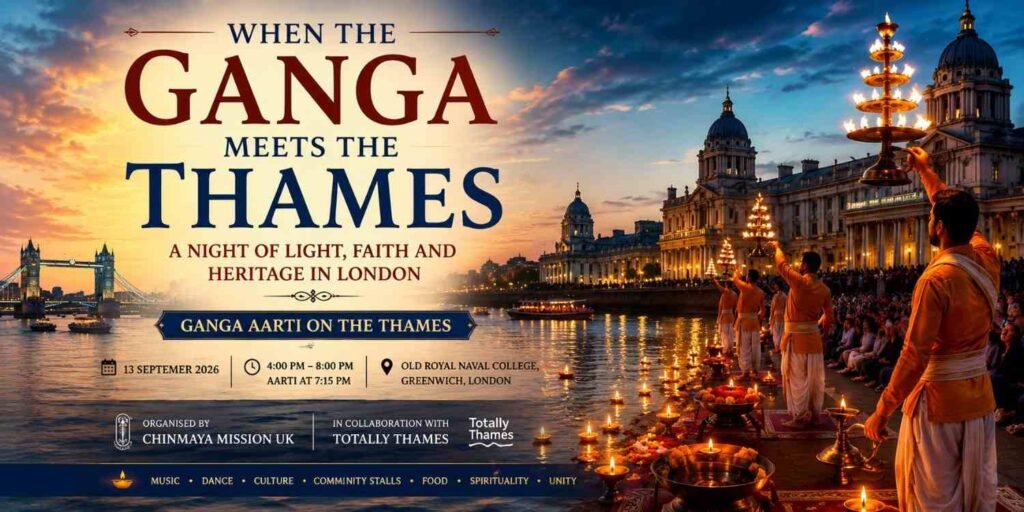
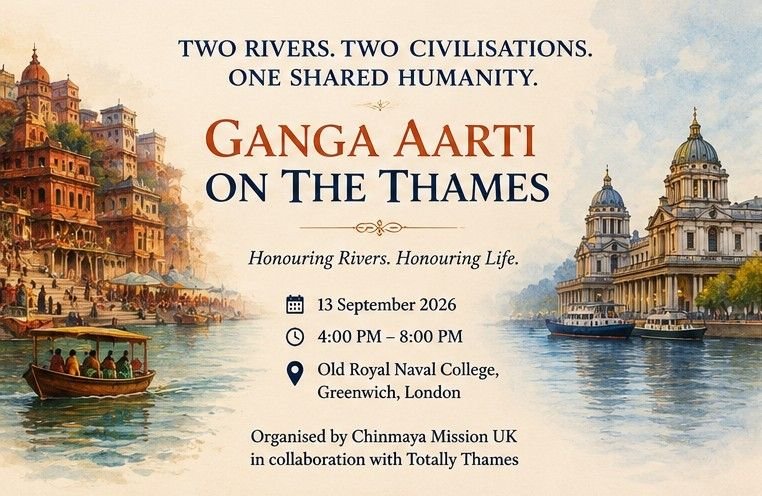
There will be a different kind of evening on the banks of the River Thames on Sunday, 13 September 2026.
As the afternoon slowly gives way to evening, people will begin arriving at the historic Old Royal Naval College in Greenwich. Some will come out of curiosity. Some will come because they have grown up with memories of India. Some will come as devotees. Others will simply wish to experience something beautiful and unfamiliar.
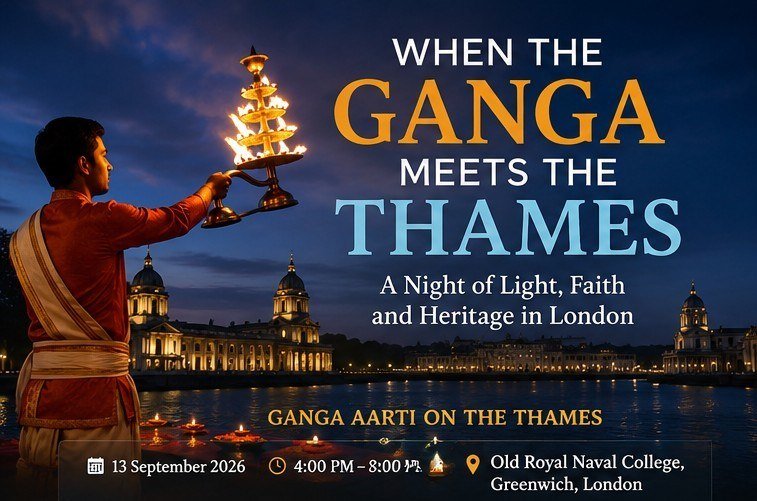
And as the evening deepens, hundreds of lamps will be raised beside the Thames.
For a moment, an ancient Indian river tradition will appear beside one of Britain’s most historic rivers.
It will be Ganga Aarti on the Thames.
The main Aarti is scheduled for 7:15 PM, within an event running from 4:00 PM to 8:00 PM. The programme is being organised by Chinmaya Mission UK, in collaboration with Totally Thames, and will include music, dance, cultural activities, community stalls and food before the main ceremony.
It is more than a programme of entertainment.
It is a meeting of cultures, memories and rivers.
When an Indian tradition travels to London:
For generations, Indians have stood on the banks of the Ganga to offer lamps as the evening descends.
In cities such as Varanasi, Haridwar and Rishikesh, the sight is familiar: priests holding lamps, bells ringing, devotional music filling the air and the river reflecting hundreds of points of light.
The ceremony is known as Ganga Aarti.
But what happens when the same tradition is performed thousands of miles away, beside the Thames?
Does the ceremony lose its meaning because the Ganga is not present?
Perhaps not.
Because traditions are not only about geography. They are also about memory.
An Indian living in London may be separated from the Ganga by thousands of miles, but the river can remain alive in family stories, religious traditions, literature, music and childhood memories.
For such people, an Aarti beside the Thames may become a symbolic bridge between the land they came from and the city in which they now live.
Two rivers, two civilisations:
There is something deeply symbolic about choosing the Thames for such a ceremony.
The Ganga and the Thames are very different rivers.
One flows through the heart of the Indian subcontinent; the other flows through England and through the heart of London.
Yet both have shaped the civilisations around them.
The Ganga has nourished communities, agriculture, pilgrimage, literature, philosophy and spiritual traditions for centuries.
The Thames has shaped London’s growth, trade, transport, commerce and maritime history.
London itself would be difficult to imagine without the Thames.
India’s cultural imagination would be difficult to understand without the Ganga.
So when an Indian lamp is raised beside the Thames, the ceremony can be understood as a symbolic meeting of two rivers that have played extraordinary roles in human history.
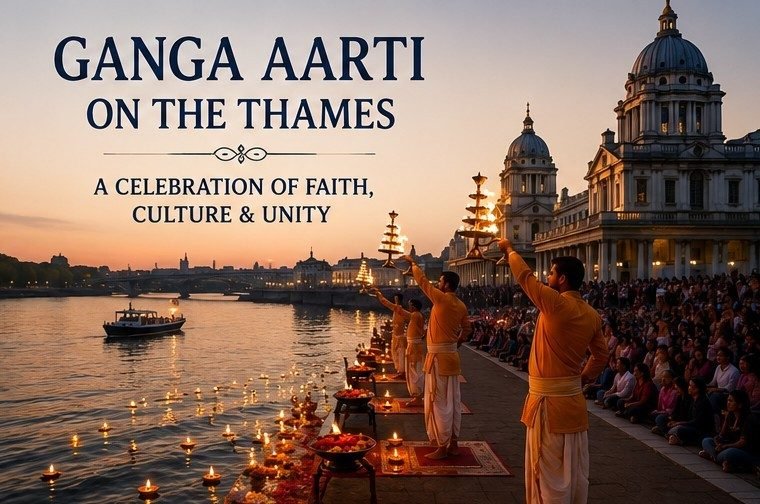
It is not a claim that the Thames is the Ganga.
It is a recognition that rivers have a universal importance to human civilisation.
Who is organising the event?
The event is being organised by Chinmaya Mission UK, in collaboration with Totally Thames.
Chinmaya Mission has long been associated with the teaching and dissemination of Vedanta and Indian spiritual wisdom, together with educational and community activities.
Its involvement gives the ceremony its spiritual and cultural foundation.
Totally Thames, meanwhile, provides a broader London context. The annual festival celebrates the River Thames through arts, culture, heritage, environmental activities and community participation.
The partnership is therefore particularly appropriate.
One organisation brings the Indian spiritual tradition.
The other brings London’s great river into the centre of a wider cultural festival.
The result is something neither exclusively Indian nor exclusively British.
It is a London event inspired by an Indian tradition.
What will happen on the day?
The afternoon programme will begin at 4:00 PM.
Visitors will be able to enjoy music, dance, cultural performances, food and community stalls.
Families can attend together. Children can experience Indian cultural traditions in a setting very different from the temples and festivals they may know from India.
There will also be an opportunity to learn about the meaning and significance of Ganga Aarti before the main ceremony.
Then, at approximately 7:15 PM, as daylight begins to fade, the central moment will arrive.
The lamps will be lit.
The Aarti will begin.
The river will continue its quiet journey towards the sea.
And the Thames will become the setting for one of India’s oldest and most recognisable expressions of reverence for a river.
What does Ganga Aarti actually mean?
To understand the event, one has to look beyond the spectacle of lamps.
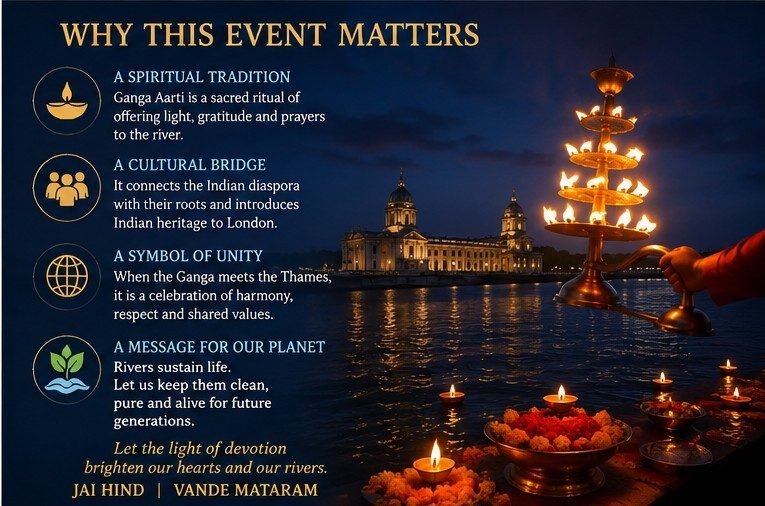
The word “Aarti” refers to a Hindu ritual in which light is offered reverentially.
In the Ganga Aarti tradition, the river is honoured as Ganga Mata—Mother Ganga.
For devotees, the Ganga is far more than water flowing from the Himalayas towards the sea.
She is associated with purity, life, spiritual renewal and divine grace.
The lamp is therefore not simply decoration.
It represents light.
Light has a profound place in Indian thought.
It is associated with knowledge, wisdom, hope and the removal of darkness.
The raising of lamps before the river can consequently be understood as an expression of gratitude and reverence.
Why bring the Ganga Aarti to the Thames?
This is perhaps the question that will occur to many Londoners.
Why perform an Indian river ceremony beside the Thames?
The answer lies partly in the changing life of the Indian diaspora.
The first generation of Indians who settled in Britain often carried India in their memories.
Their children grew up between two worlds.
Their grandchildren are increasingly British in their everyday lives while still inheriting fragments of Indian culture from their families.
For this younger generation, cultural traditions cannot always remain exactly as they were practised in India.
They must be explained.
They must be shared.
And sometimes they must find a new geographical home.
The Thames therefore becomes a new stage upon which an old Indian tradition can be understood.
A ceremony for Indians—and for everyone
The significance of the event is also found in its openness.
It is not necessary to be a Hindu to attend.
One may attend as an Indian-origin Londoner wishing to reconnect with heritage.
One may attend as a Hindu devotee.
One may attend as a British citizen interested in Indian culture.
One may attend because of an interest in music and dance.
One may attend simply because the idea of seeing a river ceremony beside the Thames is intriguing.
This openness is important.
Cultural traditions become more meaningful when they are shared respectfully rather than kept hidden within closed communities.
An Indian family can say to its London neighbours:
“This is something from our heritage. Come and experience it with us.”
That simple invitation can become an act of friendship.
A lesson for children
Perhaps the most important audience will be children.
A child born in London may know the word “Ganga” but may never have seen the river.
He or she may know that grandparents once visited Varanasi or Haridwar, but those stories can sometimes feel like distant history.
Then comes an evening beside the Thames.
The child sees lamps being raised.
The child hears Indian music.
The child watches a traditional ceremony.
Suddenly, the history described by grandparents becomes something visible.
Something alive.
Something that can be experienced in London.
This is how cultural heritage survives—not merely through books, but through experience.
Beyond religion: the message of the river
There is another dimension to the ceremony that deserves attention.
The modern world has increasingly recognised that rivers need protection.
India has a long tradition of treating rivers with reverence, but reverence alone is not enough.
If a river is regarded as sacred, it should also be kept clean.
The same principle applies to the Thames.
The river should not merely be admired from its banks. It should be protected.
This is where an ancient spiritual tradition can meet modern environmental consciousness.
A lamp offered to a river can carry a simple message:
Be grateful for water.
Respect nature.
Protect the river.
The symbolism becomes even more powerful because the event is part of Totally Thames, a festival that also includes environmental and community activities connected with the river.
The irony of sacred rivers
There is also an important lesson hidden within the celebration.
India has enormous emotional and spiritual reverence for the Ganga, yet the river has faced serious pollution and ecological pressures.
Britain’s Thames, too, has experienced severe pollution during the history of industrial London.
Both stories demonstrate that civilisation can depend upon a river while simultaneously damaging it.
The modern generation therefore has a responsibility to transform reverence into action.
The real meaning of a river ceremony should not end when the lamps are extinguished.
It should continue in the way people treat water, nature and the environment.
Greenwich becomes a meeting place
The choice of Greenwich adds another layer of meaning.
The Old Royal Naval College stands beside the Thames and is associated with Britain’s maritime history.
Ships once travelled from the Thames towards distant parts of the world.
Today, people from those distant parts have made London their home.
The story has come full circle.
India, once connected to Britain through a complicated and often difficult colonial history, is now represented in London by millions of people of Indian origin who contribute to British society in countless ways.
The Ganga Aarti in Greenwich is therefore taking place not in an isolated Indian space but in the heart of historic London.
That itself is significant.
From separation to integration
There was a time when immigrants were often expected to abandon their old identities in order to integrate into a new society.
Modern multicultural London offers a different possibility.
Integration does not necessarily mean forgetting where one came from.
A person can become fully part of British society while retaining Indian heritage.
One can celebrate Diwali, observe Indian traditions, speak an Indian language at home, cook Indian food and still be an active participant in British civic life.
Cultural identity and social integration need not be enemies.
They can strengthen each other.
Ganga Aarti on the Thames offers an example of that possibility.
India meets Britain in the language of light
There is something universal about light.
India celebrates Diwali, the festival of lights.
Christian traditions use candles.
Jewish communities light candles during religious observances.
Many cultures associate light with hope, knowledge and goodness.
Thus, even when the origins of a ceremony are specifically Hindu, its symbolism can be understood more broadly.
A lamp shining beside the Thames can speak to people who do not know the Sanskrit prayers being recited.
It can still communicate something simple:
Darkness does not have to prevail.
A celebration of the Indian diaspora
For Indians living in London, the event can also become a celebration of their own journey.
Doctors, nurses, teachers, lawyers, engineers, scientists, businesspeople, shopkeepers, academics, artists, civil servants and countless others of Indian origin have become part of the social and economic fabric of Britain.
They have built homes here.
Their children attend British schools.
Their grandchildren may speak with London accents.
Yet India remains part of their emotional landscape.
Events such as this allow that heritage to be expressed publicly and positively.
What makes this event special?
It is not simply that an Aarti is being performed.
Ganga Aarti is performed every day in many parts of India.
What makes this event special is the setting.
An ancient Indian tradition will be presented beside the Thames, in one of the world’s most international cities, as part of a festival that celebrates London’s own great river.
That creates a remarkable cultural image:
Indian lamps reflected in the waters of the Thames.
The image itself tells a story.
A moment of quiet reflection
Perhaps, when the main ceremony begins at 7:15 PM, the most beautiful part will not be the music or the crowd.
It may be the moment when people become silent.
The lamps will rise.
The river will move.
The evening sky will darken.
The historic buildings of Greenwich will stand behind the gathering.
And for a few moments, people may forget the noise of London.
A visitor might think of India.
An Indian may think of a parent or grandparent.
A child may wonder about a river he or she has never seen.
Someone else may simply look at the light reflected on the water.
Different people may experience the same moment differently.
That is the beauty of culture.
What should the ceremony leave behind?
When the last lamp is lowered and the crowd begins to leave, the true success of the event should not be measured only by the number of people who attended.
It should be measured by what remains in their minds.
Perhaps a child will become curious about Indian history.
Perhaps a British visitor will learn something new about Hindu culture.
Perhaps an Indian-origin family will feel closer to its heritage.
Perhaps someone will think more seriously about protecting rivers.
Perhaps two strangers from different backgrounds will begin a conversation.
That is how cultural events quietly build bridges.
A bridge between the Ganga and the Thames:
The Ganga Aarti on the Thames can therefore be understood at several levels.
For the devotee, it is an offering of light.
For the Indian diaspora, it is a connection with the motherland.
For children, it is a lesson in heritage.
For Londoners, it is an introduction to Indian culture.
For environmentalists, it can be a reminder of the responsibility to protect rivers.
For the wider community, it is an example of multicultural London.
And for everyone present, it can simply be a beautiful evening beside the river.
The Ganga does not need to physically flow into the Thames for the two rivers to meet.
They meet through memory.
They meet through culture.
They meet through people.
And they meet through the universal human dependence upon water.
The final lamp:
On 13 September, as evening falls over Greenwich, the lamps will glow beside the Thames.
The Ganga will be remembered.
The Thames will be honoured in a different way.
India’s ancient heritage will meet modern London.
And perhaps the most appropriate message to carry away will be a simple one:
Let the light of tradition illuminate the present.
Let the rivers of the world remain clean and alive.
Let cultures meet without fear.
Let heritage become a bridge rather than a barrier.
And let humanity learn to live together in harmony.
The lamps may eventually go out.
The ceremony may end.
The visitors may return home.
But the message can continue to travel—like the rivers themselves.
From the Ganga to the Thames.
From India to Britain.
From one generation to another.
Ganga Mata ki Jai.
Jai Hind.
Vande Mataram.