

Gangeshwar Mahadev: The Unspoken Completion of Jyotirlinga Darshan
By Lokanath Mishra
In the sacred journey of a devotee, the darshan of the twelve Jyotirlingas of Lord Shiva is regarded as one of the highest spiritual accomplishments. Yet, ancient spiritual wisdom quietly reminds us that this divine pilgrimage remains incomplete without the darshan of Gangeshwar Mahadev—a timeless shrine where the eternal Lord is worshipped not by human hands alone, but by the ceaseless waves of the ocean itself.
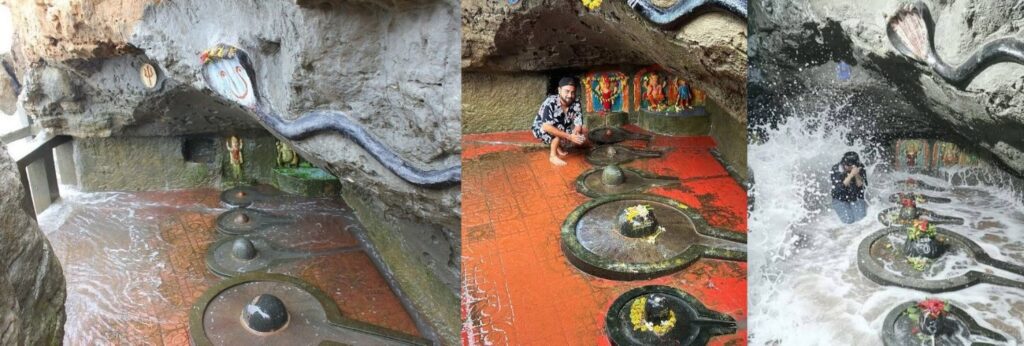
A Temple Beyond Time
Located about 3 kilometers from the Diu Bus Station, in the serene village of Fudam, stands the ancient Gangeshwar Mahadev Temple, resting humbly on the shores of the Arabian Sea. Far removed from worldly noise, this sacred site radiates tranquility and divine presence. According to ancient belief, the temple was constructed more than 5,000 years ago by the Pandava brothers during their exile, making it one of the most ancient living shrines of Lord Shiva.
Unlike grand temples adorned with towering spires, Gangeshwar Mahadev exists in sublime simplicity. It is essentially a natural cave temple, formed amidst coastal rocks, where nature itself becomes the sanctum sanctorum.
The Lord of Ganga and the Sea
The presiding deity here is Lord Gangeshwar, revered as the divine master of River Ganga, which descended to Earth through the matted locks of Lord Shiva. At this sacred confluence, the ocean pays homage to the Lord who once restrained the mighty river to protect creation.
The temple houses five ancient Shivlingas of varying sizes, believed to have been installed by the five Pandava brothers—Yudhishthira, Bhima, Arjuna, Nakula, and Sahadeva. These Shivlingas stand in eternal meditation as the waves of the Arabian Sea rhythmically bathe them, performing an uninterrupted Abhishek day and night.
When Nature Becomes the Priest
One of the most profound aspects of Gangeshwar Mahadev is the absence of a traditional priesthood. Here, the ocean itself is the pujari, offering water, devotion, and surrender with every wave. Whatever a devotee offers—flowers, water, or prayers—is gently accepted and immediately returned to nature, teaching the deep spiritual truth of impermanence and detachment.
Devotees wait patiently for the moment when the waves recede, allowing them to touch the sacred Shivlinga, experiencing a fleeting yet powerful connection with the divine. That brief touch carries the weight of timeless devotion and leaves an indelible mark on the soul.
A Living Symbol of Surrender
At the entrance of the temple, the presence of Lord Ganesha, Lord Vishnu, and Goddess Lakshmi signifies harmony among the divine forces—creation, preservation, and transformation. This sacred alignment reinforces the cosmic balance embodied by Lord Shiva.
The mesmerizing sight of roaring waves bowing before the silent Lingas evokes profound humility. It reminds devotees that even the mightiest forces of nature surrender before the Supreme Consciousness.
Spiritual Significance Beyond Ritual
Gangeshwar Mahadev is not merely a temple—it is a living spiritual experience. It teaches that true worship does not require elaborate rituals or grand offerings. What matters is pure devotion, humility, and surrender. Standing before the Shivlingas as the sea washes away all offerings, one realizes that only devotion remains eternal.
For seekers who have visited the twelve Jyotirlingas, this sacred shrine offers a deeper realization—that Shiva is not confined to form or structure, but lives wherever devotion flows naturally, just like the ocean meeting the shore.
Conclusion
To visit Gangeshwar Mahadev is to witness nature and divinity in perfect union. It is a reminder that Lord Shiva exists beyond temples, beyond priests, and beyond time. The darshan here is silent yet thunderous, simple yet infinitely profound.
Thus, the ancient belief holds true:
Without the darshan of Gangeshwar Mahadev, the pilgrimage of the twelve Jyotirlingas remains spiritually incomplete.
May every seeker who stands before these wave-washed Lingas receive the blessings of eternal peace, surrender, and divine realization.
Om Namah Shivaya. 🕉️
ଚନ୍ଦ୍ରଭାଗା ତୀର୍ଥ ଓ ଅର୍କକ୍ଷେତ୍ରର ସେଇ ପବିତ୍ର ପ୍ରଭାତ…
ସୂର୍ଯ୍ୟାର୍ଘ୍ୟ
Who Should Undertake Continuous Pilgrimage for Devata Darsan?