
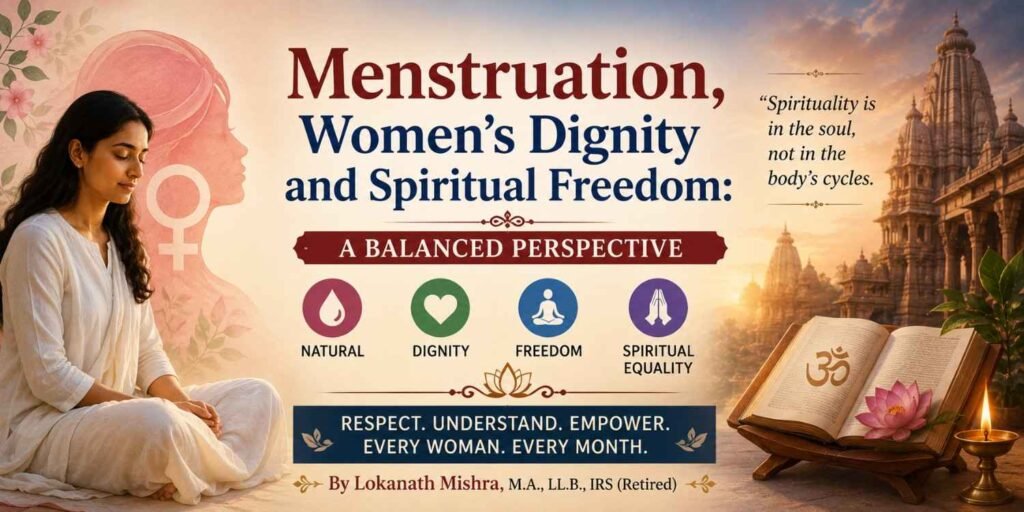
Menstruation, Women’s Dignity and Spiritual Freedom: A Balanced Perspective:
By Lokanath Mishra, M.A., LL.B., IRS (Retired)
Introduction:
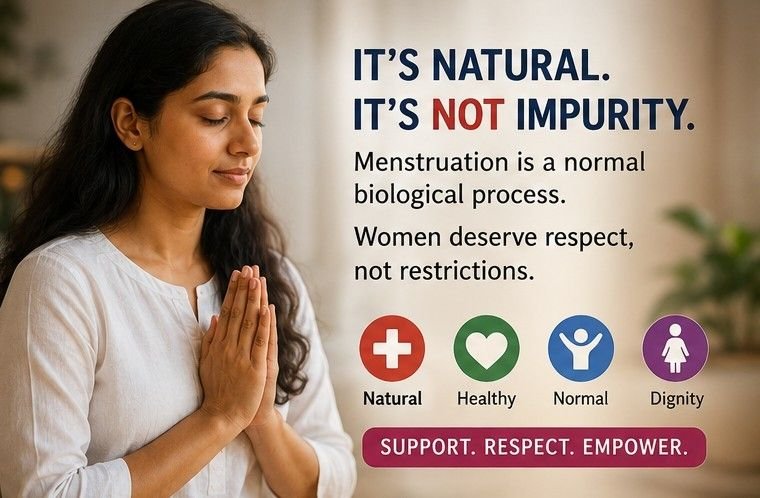
Menstruation is a natural biological process experienced by women throughout their reproductive years. Every month, the female body undergoes a normal physiological cycle that is essential for human reproduction. Modern medical science recognises menstruation as a healthy and natural function of the body, not as a disease or a condition that makes a woman impure.
Despite this scientific understanding, various customs relating to menstruation continue to exist in different societies. In some Hindu families and communities, women traditionally refrain from entering temples, performing certain religious rituals, cooking, or participating in household ceremonies during their menstrual period. In some places, they are also expected to remain physically separated from other family members. However, these customs are not uniform throughout Hindu society and vary considerably according to regional, family and cultural traditions.
Science and Menstruation:
Medical science clearly states that menstruation is a normal biological process resulting from hormonal changes in the female reproductive system. It is no more unnatural than other normal bodily functions.
A menstruating woman is not a source of pollution or impurity. She is capable of carrying out her normal daily activities unless she experiences pain, fatigue or other medical symptoms. Many women continue to work as doctors, teachers, scientists, judges, soldiers, pilots, athletes and public servants during menstruation without any difficulty.
Therefore, from a scientific perspective, there is no general medical basis for imposing compulsory social or religious restrictions upon every woman during her menstrual period.
Historical and Cultural Background:
Many traditional restrictions relating to menstruation developed in ancient societies where access to sanitation, clean water, privacy and menstrual hygiene products was extremely limited.
Some historians believe that these customs may originally have been intended to provide women with physical rest during a time when household work was particularly demanding. Over the centuries, however, in some places these practices came to be interpreted as religious prohibitions rather than voluntary periods of rest.
Today, improved medical knowledge and better living conditions invite us to re-examine such customs with compassion, wisdom and respect.
Spiritual Equality:
The central teachings of Hindu philosophy emphasise that the Divine resides within every human being.
The Upanishads teach the unity of all existence, while the Bhagavad Gita repeatedly emphasises devotion, righteous conduct and purity of mind rather than physical conditions.
Spiritual progress depends upon faith, compassion, truthfulness, self-control and devotion. These qualities are not determined by whether a woman is menstruating.
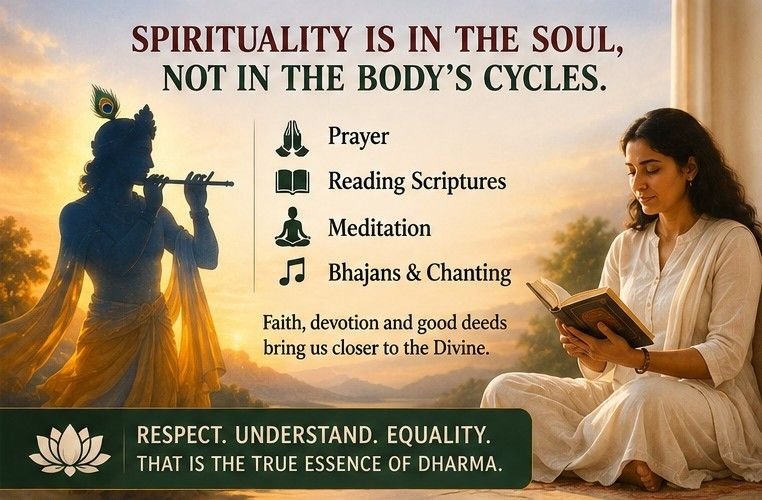
For many women, prayer, meditation, reading sacred scriptures, chanting God’s name, listening to Bhajans and participating in spiritual activities provide emotional comfort and inner peace. Preventing a woman from seeking spiritual strength solely because she is menstruating may cause unnecessary emotional distress.
Freedom of Personal Choice:
Every woman should be treated with dignity and respect.
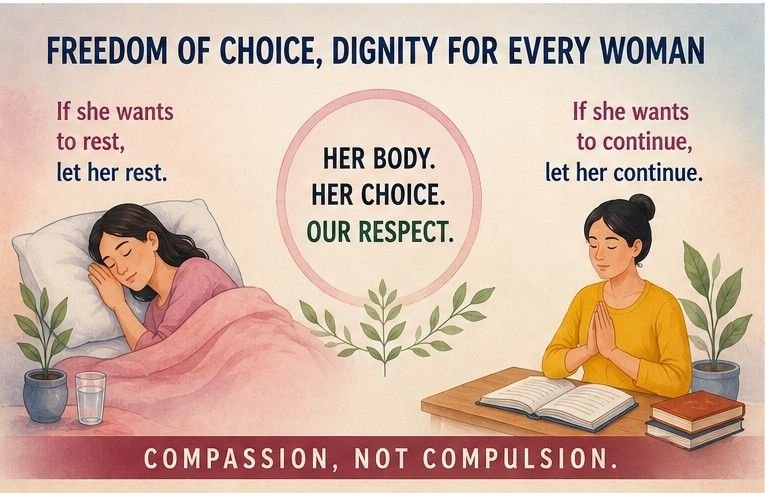
If a woman feels physically uncomfortable during menstruation, she may voluntarily choose to rest and reduce her workload. That decision deserves full support from her family.
On the other hand, if she feels healthy and wishes to continue her daily work, offer prayers, read religious scriptures or engage in meditation, she should also be free to do so according to her own conscience and the traditions she follows.
Compassion should replace compulsion.
A Society Based on Respect:
A progressive society should encourage understanding rather than discrimination.
Menstruation should never become a reason for humiliation, isolation or unequal treatment. Families should ensure that women receive proper nutrition, medical care, emotional support and hygienic facilities during this period.
Religious faith should inspire kindness, dignity and mutual respect. Customs that bring comfort and are voluntarily observed may continue, while practices that cause unnecessary hardship or social exclusion deserve thoughtful discussion within families and communities.
Conclusion
Menstruation is a natural and healthy biological process. Modern science does not support the view that menstruating women are inherently impure or incapable of participating in normal daily life.
Whether a woman chooses to rest or to continue her religious and spiritual practices should primarily be a matter of her health, personal conviction and the traditions she freely embraces.
A compassionate society should ensure that no woman is made to feel inferior because of a natural biological process. True spirituality lies not in exclusion but in respect, understanding, equality and devotion.
When women are treated with dignity and allowed to make informed choices about their own lives, both society and spirituality become stronger.