
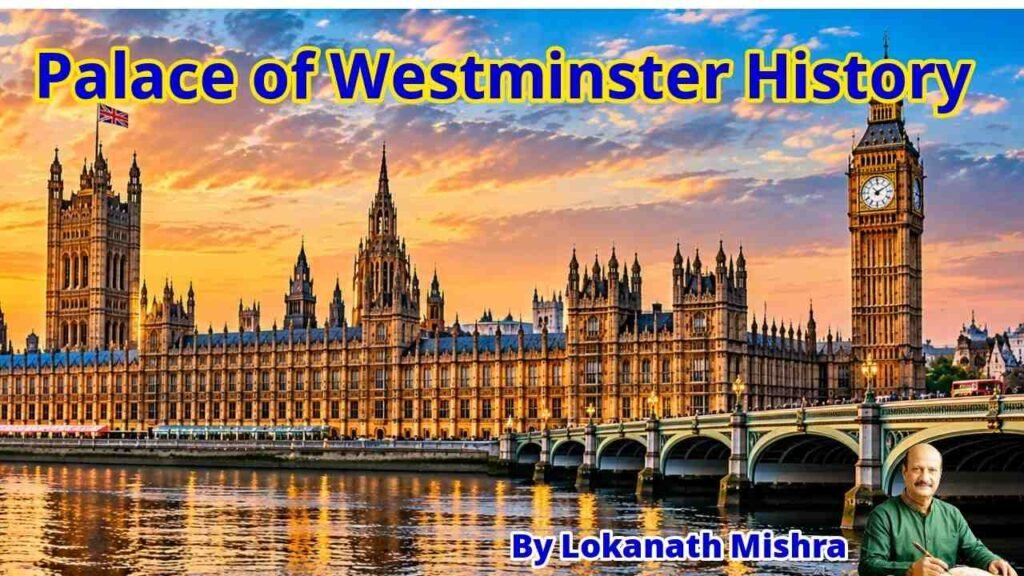
A Journey Through British History: My Visit to the Palace of Westminster:
By Lokanath Mishra, IRS ( retired)
Introduction:
During my visit to London, I had the memorable opportunity to enter and explore the Palace of Westminster, popularly known throughout the world as the Houses of Parliament. This was not merely a visit to a magnificent historic building. It was, in a very real sense, a journey through more than nine centuries of British political, constitutional, legal and social history.
The Palace of Westminster stands beside the River Thames and remains the home of the two Houses of the Parliament of the United Kingdom—the House of Commons and the House of Lords. The history of Parliament at Westminster stretches back for more than 900 years, while the present Palace largely dates from the nineteenth-century rebuilding that followed the devastating fire of 1834.
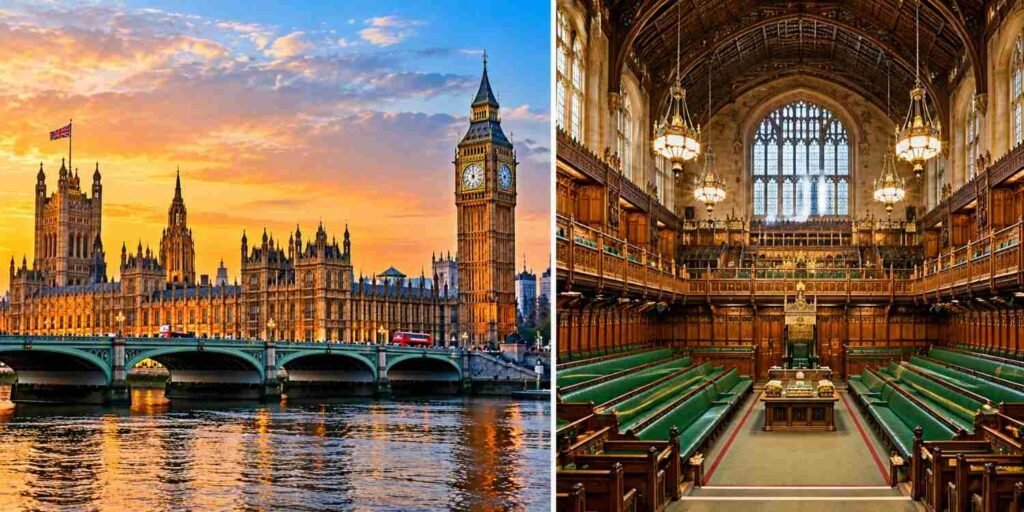
The summer guided tour offered visitors an opportunity to explore this historic building under the guidance of an expert in-house guide. The approximately 90-minute tour brought together history, art, architecture and the contemporary working of Parliament. It included some of the most important interiors of the Palace—Westminster Hall, Central Lobby, the House of Commons Chamber and the House of Lords Chamber.
For someone interested in history and public institutions, the experience was particularly fascinating because the building is not simply a museum. It is a living and working Parliament.
The Palace of Westminster and the Birth of Parliamentary Tradition:
The story of Westminster begins long before the present Gothic building was constructed. Westminster was associated with Anglo-Saxon kings and subsequently became an important royal centre under the Norman monarchs.
The ancient Palace developed over centuries as a royal residence, administrative centre, legal centre and meeting place for Parliament. The institutions of government, law and Parliament gradually became closely associated with Westminster.
Thus, when we enter the present Palace of Westminster, we are entering a site where political and constitutional developments have taken place over many generations.
The modern Palace should therefore be understood not merely as a nineteenth-century architectural masterpiece, but as the successor to a much older centre of British government.
Westminster Hall: The Great Survivor of Nine Centuries:
The first and perhaps most impressive part of the tour was Westminster Hall.
Westminster Hall is the oldest surviving building on the parliamentary estate and is virtually the only major part of the ancient Palace that survives substantially in its original form. Its history goes back to 1097, when it was built under William II, known as William Rufus, son of William the Conqueror.
Standing inside the enormous medieval hall, one can immediately appreciate why it has survived in the national memory as one of the great historic spaces of Britain.
The Hall was approximately 73 metres long and 20 metres wide. Its immense dimensions made it one of the largest halls in Europe at the time of its construction.
But its importance is not simply architectural.
Westminster Hall and the History of Justice:
For centuries Westminster Hall was closely associated with the administration of justice. The great law courts of England operated here, and some of the most famous state trials in British history took place within or around the Hall.
Among those historically associated with Westminster Hall were the trials of Sir William Wallace, Sir Thomas More, Guy Fawkes, the Earl of Strafford, King Charles I and Warren Hastings.
The Hall therefore witnessed some of the most dramatic confrontations between the Crown, Parliament, the courts and individuals accused of threatening the established order.
Standing there today, it is remarkable to think that the same space has witnessed royal ceremonies, parliamentary events, legal proceedings, political controversies and national commemorations across many centuries.
The Magnificent Hammer-Beam Roof:
One of the outstanding features of Westminster Hall is its magnificent medieval hammer-beam roof.
The roof is particularly remarkable because it spans the great width of the Hall without the rows of supporting columns that one might expect in such a vast medieval building. The present roof is associated with the rebuilding of the Hall during the reign of Richard II, and it became one of the great achievements of medieval English architecture.
The roof is not merely an architectural achievement. It is a symbol of the continuity of British history. Beneath it, generations of monarchs, judges, parliamentarians and citizens have participated in events that shaped the nation.
The Great Fire of 1834:
Perhaps the most dramatic episode in the history of the Palace occurred on 16 October 1834.
A fire caused by the burning of old Exchequer tally sticks devastated most of the medieval Palace of Westminster. The flames destroyed the House of Lords and badly affected the House of Commons and surrounding buildings. Westminster Hall itself was seriously threatened.
Remarkably, Westminster Hall survived.
The preservation of the Hall was due to several factors, including the strength and thickness of its medieval walls, the firefighting efforts directed towards its roof and favourable changes in the wind.
The survival of Westminster Hall gave the architects of the new Palace a precious link with medieval Westminster.
The Rebuilding of the Palace:
Following the destruction of 1834, Britain faced the enormous task of constructing a new home for Parliament.
A competition was organised, and the design by Sir Charles Barry was selected. Barry designed the overall Palace in the Gothic Revival tradition, while Augustus Welby Northmore Pugin played a major role in the detailed architectural and interior design.
The first stone of the new Palace was laid in 1840. The House of Lords Chamber was completed in 1847, the House of Commons Chamber in 1852, and the rebuilding was substantially completed by 1870.
The result was one of the world’s most recognisable parliamentary buildings.
Gothic Architecture and Parliamentary Democracy:
The architecture of the Palace is inseparable from its political purpose.
Barry designed the building in the Perpendicular Gothic tradition, while Pugin created many of the extraordinarily rich interiors. The result combines medieval architectural inspiration with the requirements of a modern nineteenth-century parliamentary institution.
Everywhere one looks there are symbols—royal emblems, coats of arms, statues, paintings, stained glass, carved stonework and intricate decoration.
The building therefore tells a political story through architecture.
Central Lobby: The Heart of the Palace:
From Westminster Hall, the tour proceeded towards Central Lobby, one of the most important spaces within the Palace.
Central Lobby is an octagonal hall and effectively forms the crossroads of the Palace. Corridors connect it with Westminster Hall, the House of Commons and the House of Lords.
Historically and constitutionally, this is an especially interesting place because it represents a meeting point between the two Houses and between Parliament and the public.
Members of Parliament can meet constituents in Central Lobby, and members of the public can use the area to seek contact with their MPs.
The very word “lobby” has acquired an important political meaning in the English language. Its parliamentary use is connected with the idea of meeting Members of Parliament and seeking their support or influence.
The Four Nations of the United Kingdom:
Central Lobby also contains important national symbolism.
Four large mosaic panels represent the patron saints of the constituent nations of the United Kingdom: St George for England, St David for Wales, St Andrew for Scotland and St Patrick for Northern Ireland.
These symbols remind visitors that the United Kingdom is a union of distinct historical nations whose political relationships have developed over centuries.
Thus, Central Lobby is not simply a beautiful architectural space. It is also a visual representation of the Union.
The House of Commons Chamber:
The next major part of the tour was the House of Commons Chamber, where elected Members of Parliament debate legislation, scrutinise the Government and represent their constituents.
The Commons is the chamber most closely associated with the principle of representative democracy in the United Kingdom.
The modern House of Commons has evolved considerably from its medieval origins. Its present Chamber forms part of the nineteenth-century Palace rebuilt after the fire of 1834.
The Chamber is therefore both a historical space and an active centre of contemporary political life.
From Royal Power to Parliamentary Government:
The history of the House of Commons reflects the gradual transformation of Britain’s constitutional system.
In earlier centuries, the monarch exercised far greater direct authority. Over time, Parliament increased its influence over taxation, legislation and government.
The evolution was neither simple nor peaceful. It involved conflicts between monarchs and Parliament, civil war, the execution of Charles I, the Restoration of the monarchy, the Glorious Revolution and subsequent constitutional developments.
The Chamber visited today is therefore the product of centuries of political evolution.
Its importance lies not in the grandeur of the room alone, but in the principle that government must ultimately be accountable to Parliament and, through elected Members, to the people.
The House of Lords Chamber:
The tour then proceeded to the House of Lords Chamber, another magnificent interior of the Palace.
The House of Lords is the second chamber of the UK Parliament. It plays an important role in examining legislation, scrutinising government activity and contributing to the development of public policy.
The Chamber is particularly distinguished by its elaborate decoration and Pugin-designed interiors. Its appearance reflects the historic relationship between the Crown, the aristocracy, religion and Parliament.
The contrast between the Commons and Lords is therefore not accidental. The two Chambers represent different historical traditions within the British constitutional system.
The Lords and the Evolution of the Constitution:
The history of the House of Lords is closely connected with the evolution of the British state.
Originally, the upper chamber represented powerful nobles and senior clergy. Over the centuries, its composition and powers changed.
Modern reforms have transformed the House considerably. In particular, the House of Lords Act 1999 removed the automatic right of most hereditary peers to sit and vote in the House.
Today the Lords contains life peers, bishops and a limited number of hereditary peers, and it continues to serve as a revising and scrutinising chamber.
Its historical character remains visible in the architecture, but its constitutional role continues to evolve.
The Palace as a Living Institution:
One of the most striking aspects of the visit was the realisation that the Palace of Westminster is not simply a historic monument.
It is a working parliamentary building.
Debates, committee meetings, legislative discussions, government scrutiny and other parliamentary activities continue within its walls.
This gives the building an unusual character. Visitors are simultaneously walking through history and observing an institution that continues to shape the present.
The official Parliament visitor information itself emphasises that tours take place within a working parliamentary building and that access can sometimes be affected by parliamentary business.
Architecture as a Record of History:
The Palace can almost be read like a history book.
Westminster Hall represents medieval England.
The Gothic Revival Palace represents Victorian Britain’s attempt to create a monumental home for constitutional government.
Central Lobby represents communication between Parliament and the public.
The Commons Chamber represents elected representation.
The Lords Chamber represents the historical and continuing role of the second chamber.
Together these spaces tell the story of the gradual development of British parliamentary government.
From Westminster to the World:
The importance of Westminster extends beyond Britain.
The British parliamentary model has influenced constitutional development in many countries around the world, particularly those with historical links to the United Kingdom.
Institutions such as parliamentary debate, cabinet government, legislative scrutiny and the principle of government accountability have influenced political systems far beyond the British Isles.
A visit to Westminster therefore provides an opportunity to understand not only British history but also an important part of the history of modern constitutional government.
The Significance of the Visit:
The 90-minute guided tour may appear short in comparison with the nine centuries of history contained within the building, but it provides an extraordinary introduction to the Palace.
The expert guide connects architecture with history and parliamentary practice, enabling visitors to understand how the different parts of the building relate to one another.
For me, the most memorable aspect was the continuity between the past and the present.
To stand in Westminster Hall, whose history goes back to 1097, and then enter spaces where modern Members of Parliament and Peers continue their daily work is to experience an extraordinary connection between different periods of history.
A Personal Reflection on Westminster:
My visit to the Palace of Westminster was therefore much more than a sightseeing experience.
It was an educational journey through the development of British civilisation, constitutional government and parliamentary democracy.
The magnificent architecture naturally attracts the eye, but the deeper significance lies in the events that took place within these walls.
Kings and queens, ministers, parliamentarians, judges, reformers, revolutionaries and ordinary citizens have all contributed to the story of Westminster.
The Palace reminds us that political institutions are not created overnight. They evolve through centuries of conflict, compromise, reform and public participation.
Conclusion: Westminster—A Living Monument to Democracy:
The Palace of Westminster stands today as one of the world’s most recognisable symbols of parliamentary government.
Its ancient heart, Westminster Hall, carries the memory of more than nine centuries. The nineteenth-century Palace surrounding it represents Britain’s Victorian architectural ambition. The House of Commons and House of Lords continue to perform their constitutional functions, ensuring that Westminster remains a living institution rather than a monument frozen in the past.
My visit through Westminster Hall, Central Lobby, the House of Commons Chamber and the House of Lords Chamber provided a unique opportunity to see how history, architecture and democracy are woven together under one roof.
The Palace of Westminster is consequently much more than a beautiful building beside the Thames. It is a physical record of Britain’s constitutional journey—from monarchy and medieval government to representative parliamentary democracy.
To walk through Westminster is, in many respects, to walk through British history itself.
⸻
Sources for historical verification: UK Parliament’s official Living Heritage and visitor resources, including its histories of Westminster Hall, the Palace of Westminster, Central Lobby and the two Houses.