
Ancient Religions of Europe Today: Who Still Follows Them and How They Survive:
By Lokanath Mishra:
Europe is known as a Christian continent. But beneath that. ancient pre-Christian faiths never completely died.
Today they are reviving as “Modern Paganism”. “Ethnic Religions”. or “Native Faiths”.
Estimates suggest approximately 4 to 5 million practitioners across Europe and the Anglosphere. with an average annual growth rate of 8.3% between 1970 and 2010.
These groups do not worship exactly like 2 000 years ago. They are reconstructionist movements. trying to revive the traditions of their ancestors as cultural heritage.
Here is a country-wise picture of how many still have faith. and how they survive:
Northern and Western Europe: Germanic and Celtic Traditions:
This region focuses on Norse. Celtic. and Druidic revival.
United Kingdom:
Total modern Pagans: 93,686 in the 2021/22 Census. Broader count: 126,980 – 0.2% of population.
Includes Wicca. Druidry. Heathenry. Shamanism. and Witchcraft.
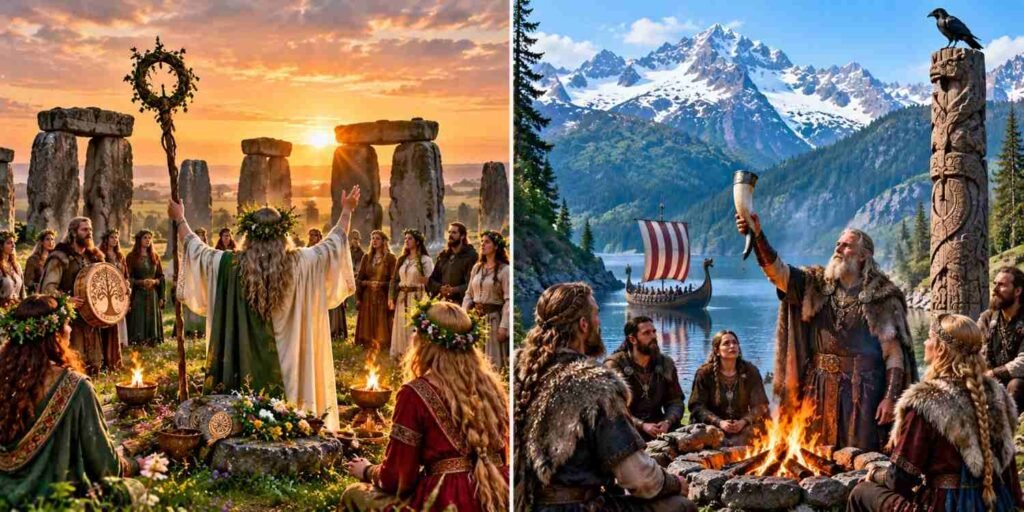
How they survive: Stonehenge is a major gathering site. Groups perform rituals. handfastings. and seasonal festivals. Legal recognition allows them to conduct marriages.
Iceland:
Ásatrúarfélagið reports over 5,000 members. about 1.4% of the population. Other data says nearly 2% or about 6,000 people.
How they survive: Ásatrú is a state-recognized religion. They perform births. marriages. and funerals. Iceland also shows the fastest growth of Paganism in Europe. 272facd4f72a
Denmark and Sweden:
Groups like Forn Siðr and Samfundet Forn Sed Sverige are state-recognized.
How they survive: Legal rights to perform marriages. public rituals. and strong ties to Nordic cultural identity.
Ireland:
3,868 people identified as Pagan in census data.
How they survive: Celtic festivals like Samhain and Imbolc are celebrated. often linked to tourism and heritage.
Central and Eastern Europe: Baltic and Slavic Revivals:
Here “Native Faiths” are strongly tied to national identity.
Lithuania:
Over 5,000 adherents of the “Old Baltic Faith” known as Romuva.
How they survive: Romuva is recognized. They protect sacred groves. perform folk rituals. and link faith to environmental conservation. Lithuania was among the last areas of Europe to be Christianized.
Latvia:
Dievturība movement maintains thousands of active members.
How they survive: Focus on folk songs. traditions. and seasonal celebrations.
Poland:
Rodnoveria groups have thousands of members.
How they survive: Cultural festivals. Slavic mythology research. and heritage protection.
Russia – Volga and Caucasus Region:
Mari El: About 15% of the population consider themselves adherents of the Mari native religion. Among Mari people it can be up to 69% among women.
Abkhazia: 8% identified with Abkhaz native faith in 2003 census. Council of Priests formally constituted in 2012.
North Ossetia: 29% identified with Uatsdin faith in 2012.
Karachay-Cherkessia: 12% followers of modern pagan faiths.
How they survive: These faiths never fully disappeared. They co-existed with Orthodox Christianity for centuries. After the fall of the Soviet Union they experienced renewal. 4762
Other European Countries:
Finland: “Indigenous Religions and Neo-Paganism” counted 35 people in 2015. Small but growing.
Netherlands: Data not listed separately. but Hinduism is the fastest-growing religion here.
France: Paganism/Neo-Paganism data not separately given. 9d4cf72aa0ca
How Are These Ancient Faiths Surviving Till Today:
- Cultural Heritage Protection: Most groups present themselves as “ethnic religions” or protectors of intangible heritage. The European Congress of Ethnic Religions coordinates advocacy at EU level.
- Legal Recognition: In Iceland. Denmark. Sweden. and Lithuania they have rights to perform legal marriages and ceremonies.
- Nature and Community: Unlike Abrahamic faiths. these religions are nature-based. Worship happens in forests. rivers. and sacred sites. Festivals follow solstices and harvests.
- Internet and Education: The decentralized nature makes counting hard. But online communities. books. and university courses help solitary practitioners connect. 4762
- Tourism and Identity: In UK. Ireland. and Iceland. pagan sites attract tourists. This gives economic support and visibility.
Key Differences from Ancient Times:
Ancient Greeks. Romans. Celts did not call themselves “Pagans”. That term came later.
Today’s practitioners are reconstructionists. They use archaeology. old texts. and folklore to rebuild rituals.
They also emphasize ecology. gender equality. and the sacred feminine.
Final Thoughts:
Ancient European religions are not museum pieces. They are living traditions.
From the 6,000 Ásatrú in Iceland to 5,000 Romuva in Lithuania to 15% of Mari people in Russia. these faiths show that Europe’s pre-Christian soul is still alive. acd4272f4762
They survive not by converting masses. but by offering meaning. community. and connection to land.
As Europe becomes more secular. these groups are growing faster than many expect.
For a traveler. visiting Greece. Iceland. or Lithuania today means you can still meet people who pray to Zeus. Odin. or Perkūnas. not in myth books. but in real temples and sacred groves.
Europe’s ancient gods did not die. They just went into the forest. and now they are coming back.