
The Last Row
By Lokanath Mishra
The wedding hall was too bright.
Light spilled from crystal chandeliers and bounced off gold-trimmed pillars until it felt unreal, like a place built for appearances rather than truth. The air smelled of jasmine and warm ghee from the sacred fire, but underneath it lingered the sharpness of sweat and nerves. Hundreds of people sat shoulder to shoulder, smiling with the careful patience of witnesses who believed they already knew how the story would end.
At the center of it all, on the raised stage, Raghav Rath waited.
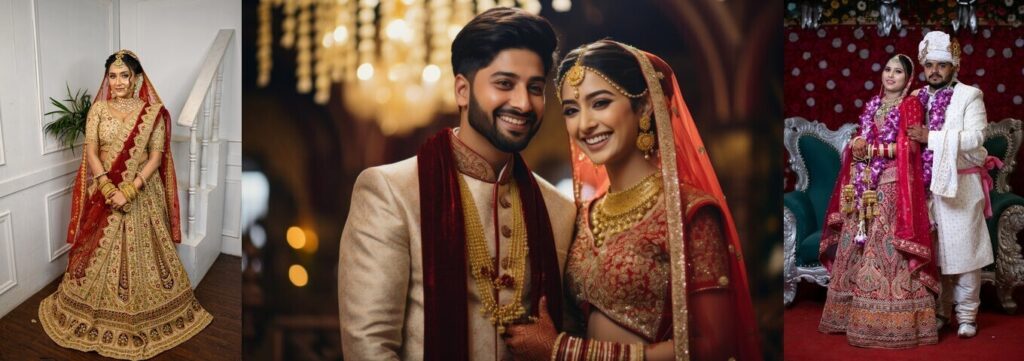
He stood straight, his cream sherwani flawless, his expression rehearsed. Only the slight tremor in his fingers betrayed him. Beside him sat Nandini Sharma, wrapped in red silk so heavy it felt like armor. Her eyes followed the rituals precisely, yet her mind drifted, restless without knowing why.
A microphone crackled.
Vikram Sharma, Nandini’s distance cousin, took the stage. He was known in the family as the harmless one—the joker, the stand-up comedian who could ease tension with a sentence. Today, dressed neatly and smiling easily, he felt like a buffer between ceremony and chaos.
He cleared his throat.
“As tradition demands,” he said lightly, “this is the moment where anyone with an objection is allowed to speak. Consider this a free speech zone—limited time offer.”
Soft laughter passed through the hall.
Raghav exhaled.
Then, from the very last row, something shifted.
It was a small movement at first, barely noticeable. A woman rose slowly, as if unsure whether the ground would hold her weight. She was young—strikingly so—but exhaustion dulled the brightness of her face. In her arms, a child slept, his cheek pressed against her shoulder, his tiny fingers knotted into her sari.
The fan above her hung lifeless.
The heat at the back of the hall was suffocating.
She took a step forward.
And then another.
People turned. Conversations faltered. A ripple of curiosity sharpened into unease.
By the time she reached the aisle, the laughter had completely vanished.
Nandini looked up.
The world seemed to tilt.
The woman’s face was unfamiliar—yet unbearable. It was not recognition that struck Nandini, but possibility. A thousand stories she had heard, a thousand warnings disguised as jokes, rushed at her all at once. Her heart pounded so loudly it drowned out the murmurs around her.
She did not wait for explanation.
Her hand moved on instinct.
The slap echoed through the hall.
For a moment, everything froze.
Then reality collapsed.
Nandini stood shaking, breath sharp, eyes blazing with humiliation and rage. Raghav stared at her in disbelief, the sting on his cheek nothing compared to the confusion tearing through his mind. Words failed him. The hall erupted before he could find any.
Chairs scraped back. Voices rose. Someone shouted. Someone else swore.
Nandini’s mother clutched her chest and slid to the floor, unconscious before anyone reached her. Her father stormed toward the house, fury sharpening his steps, returning with a stick heavy enough to break bones. The bridesmaids whispered poison into one another’s ears, certainty forming faster than truth ever could. Young men rolled up their sleeves, righteous and eager.
The child began to cry.
Only Vikram had not moved.
He watched the woman carefully, his expression unreadable. When he finally spoke, his voice was calm, almost gentle, cutting through the noise without force.
“So,” he said, smiling faintly, “you made it all the way from the last row. That deserves some explanation, doesn’t it?”
The woman lifted her eyes to his.
For the briefest second, something passed between them—recognition, amusement, a shared secret balanced on the edge of disaster.
Then she spoke.
“It’s very hot at the back,” she said simply. “The fan isn’t working. I couldn’t hear you clearly. And I couldn’t see the bride.”
The words fell into the hall like stones into still water.
Silence spread slowly, confused and incomplete.
Vikram laughed.
Not a nervous laugh. Not an awkward one.
A genuine, relieved laugh.
“Well,” he said, “that explains why my wife hates weddings.”
The sentence landed harder than the slap.
The hall gasped.
Nandini stared at him. Raghav turned, stunned. The raised stick slipped from Pratap Sharma’s hand and hit the floor with a dull thud.
“Your… wife?” someone whispered.
Vikram walked toward the woman and took the child gently into his arms. The child stopped crying at once.
“This,” Vikram said, “is Meera. And this little fellow is Aarav. My son.”
The truth rippled outward, rearranging faces, memories, assumptions.
Meera looked around the hall, her gaze steady. “We planned this,” she said quietly. “Not to hurt anyone. Only to show how quickly people decide who is guilty.”
Vikram nodded. “One woman. One child. And suddenly everyone was certain they knew the story.”
Nandini looked at her hand, still tingling.
Raghav swallowed hard.
Phones were lowered. Eyes dropped. The hall felt cooler somehow, as though a fan had finally begun to turn.
“The wedding was never in danger,” Vikram said. “But the truth was.”
The rituals resumed. The fire burned. The vows were spoken.
Yet long after the guests had eaten, long after the lights dimmed, the moment lingered—the memory of how easily certainty had formed, and how fragile it truly was.
In the last row, a fan hummed softly, spinning at last.
And for the first time that evening, the hall could breathe.
When Destiny Folded Its Hands
Fitment Factor, Pension Revision and Constitutional Mandate : Why the 8th Pay Commission Must Deliver Substantive Justice to Pensioners ?
ଯେବେ ଲତାଙ୍କ କଣ୍ଠସ୍ୱର ଶୁଣି ନେହେରୁଙ୍କ ଆଖିରୁ ଲୁହ ଝରିଥିଲା…
Pingback: The Union Budget and the Forgotten Taxpayer : Why Pensioners, Employees and the Middle Class Continue to Be Ignored - UniverseHeaven Union Budget 2026: Why Pensioners and Middle Class Are Still Ignored | Tax Relief Demands
Pingback: Mahabharata ( A Story of Dvapar Yuga in Prose) Part-33 - UniverseHeaven Bhima's Rise as King & Bakasura Clash"