
Implementation of Option 1 of the 7th Central Pay Commission : A Matter of Justice for 52 Lakh Central Government Pensioners
Lokanath Mishra, the Chief Adviser, the AIPA of CBIC.
Introduction
The recommendations of the 7th Central Pay Commission (7th CPC) marked an important milestone in the evolution of the pension system for Central Government employees. Among its many progressive proposals, one recommendation stands out for its fairness and recognition of lifelong service: the suggestion that pre-2016 pensioners should be compensated for the number of increments they had earned in their retiring pay scale by granting an additional 3% of basic pension for each increment. This recommendation, commonly associated with Option 1, seeks to restore parity between pensioners who retired before 1 January 2016 and those who retired thereafter.
Unfortunately, despite the acceptance of this principle in spirit, its implementation has remained pending. As a result, nearly 52 lakh Central Government pensioners continue to be deprived of a benefit that rightfully reflects their years of dedicated service. The issue deserves urgent attention not merely as a financial matter but as a question of equity, justice, and respect for those who devoted decades of their lives to public service.
The Significance of Annual Increments
An annual increment is not a gratuitous benefit or a temporary reward. It is earned through satisfactory service rendered over a period of time and reflects the employee’s experience, efficiency, and commitment. An individual who serves the Government for 35, 40, or even more years accumulates numerous increments through perseverance and dedication.
When an employee retires, these increments form an integral part of the final pay that determines pensionary benefits. Ignoring the value of these earned increments while fixing the pension effectively disregards decades of faithful service. Therefore, compensating pensioners by granting an additional 3% of basic pension for every increment earned is a logical and equitable recognition of their contribution.
Origin of the Recommendation
The proposal did not emerge arbitrarily. It was the outcome of persistent efforts by pensioners’ organisations, particularly the All India Pensioners’ Association of the Central Board of Indirect Taxes and Customs (CBIC). During the deliberations of the 7th CPC, representatives including Shri Ravi Malik and Shri Sushil Parik appeared before the Commission at Jodhpur and presented oral evidence supporting the demand.
Their submissions highlighted the anomalies faced by pre-2016 pensioners and argued convincingly that pension fixation should take into account the increments earned during service. The Commission appreciated the rationale and incorporated the recommendation, recognising that pension should reflect not only the last pay drawn but also the progression achieved through years of service.
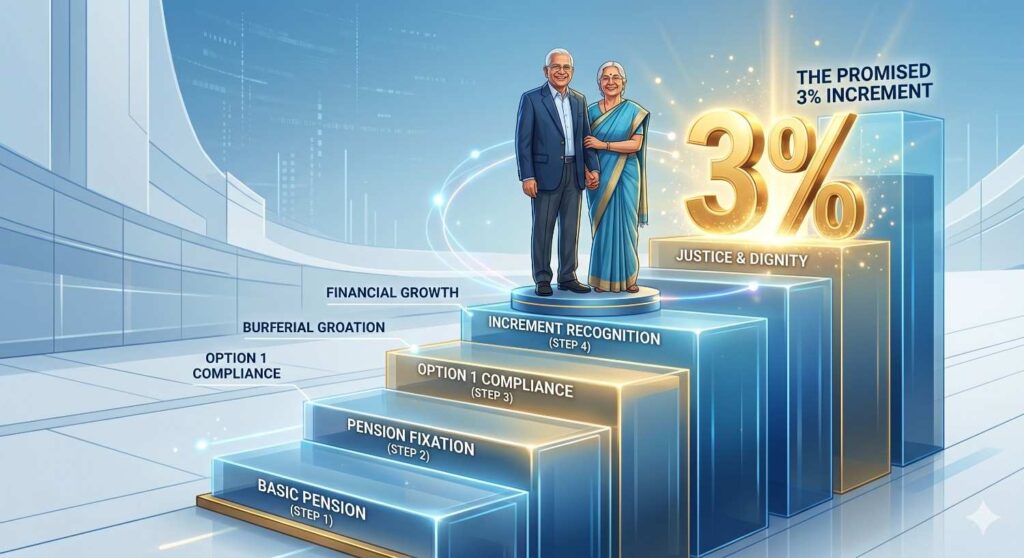
Acceptance by the Government
The Union Cabinet displayed commendable foresight by accepting the principle of granting 3% per increment to pensioners. This acceptance acknowledged that pension is not merely a welfare measure but a deferred wage earned through long and faithful service.
However, despite this acceptance, implementation has stalled on the ground that the necessary records are allegedly unavailable. This administrative objection has prevented lakhs of deserving pensioners from receiving their legitimate dues.
The Argument of Non-Availability of Data: A Weak Justification
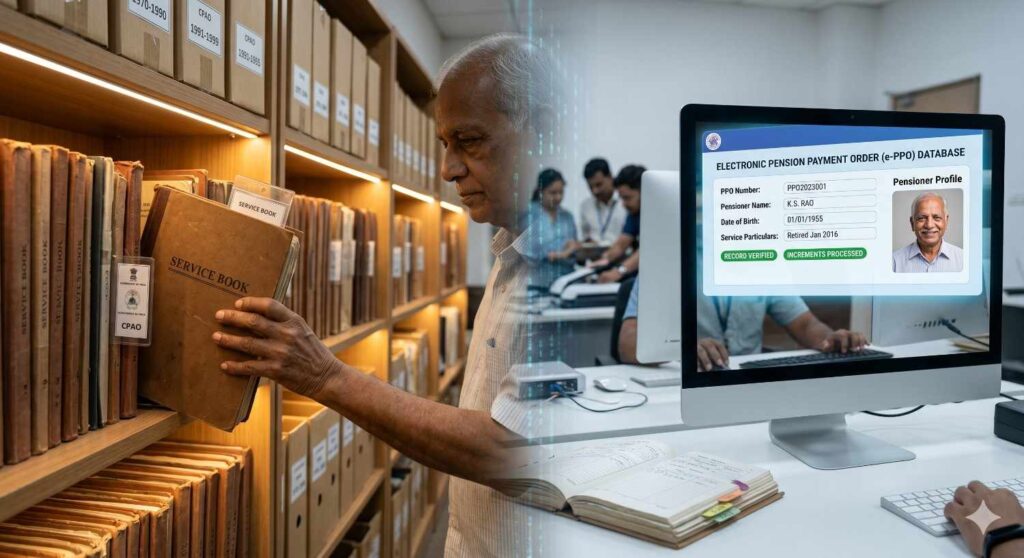
The claim that data relating to increments is unavailable does not withstand scrutiny. The service particulars of every pensioner are systematically maintained and preserved in multiple official records.
The relevant information is available in:
- The original Pension Payment Order (PPO) issued to the pensioner.
- The headquarters or office from which the employee retired.
- The Central Pension Accounting Office (CPAO), New Delhi.
- The Central Pension Processing Centre (CPPC) of the authorised bank through which pension is disbursed.
These records contain details regarding pay fixation, qualifying service, and retirement benefits. In the era of digitisation and electronic record management, retrieving information about increments is both practical and administratively feasible. Therefore, the plea that implementation is impossible due to lack of data appears neither convincing nor justified.
An Issue of Equity and Constitutional Fairness
The Supreme Court of India has repeatedly emphasised that pensioners form a homogeneous class and should not be subjected to arbitrary discrimination. Pension is not a charity but a statutory right earned through service.
If post-2016 retirees enjoy pension benefits reflecting their career progression while pre-2016 retirees are denied similar recognition, it creates an artificial distinction between individuals who performed comparable duties for the same Government. Such disparity undermines the principles of equality and fairness embodied in public administration.
Implementing Option 1 would therefore restore parity and reinforce the principle that every increment earned during service deserves recognition in retirement.
Economic and Social Impact
Providing 3% additional pension for each earned increment would have far-reaching positive consequences:
- It would substantially improve the financial security of elderly pensioners facing rising healthcare and living costs.
- It would honour decades of dedicated public service and reinforce trust in Government institutions.
- It would reduce disparities among pensioners who retired at different points in time.
- It would stimulate local economies through increased purchasing power among senior citizens.
- It would enhance the dignity and quality of life of retired employees who no longer have opportunities for supplementary income.
For many pensioners, especially those in advanced age, the enhanced pension would make a significant difference in meeting essential expenses.
Administrative Feasibility
Modern pension administration already relies on digitised databases maintained by departments, the CPAO, and pension-disbursing banks. Updating pension calculations based on recorded increments would require administrative effort but is by no means an insurmountable task.
The Government has successfully implemented nationwide revisions under previous Pay Commissions affecting millions of pensioners. Therefore, extending the benefits of Option 1 should be viewed as an achievable administrative exercise rather than an impractical undertaking.
A Call for Immediate Implementation
The continued denial of the increment-based pension benefit effectively deprives nearly 52 lakh pensioners of what they have earned through decades of honest service. Justice delayed in such matters amounts to justice denied.
The Government should therefore issue necessary orders to implement Option 1 of the 7th Central Pay Commission without further delay, ensuring that pension fixation duly recognises the increments earned during service and grants the corresponding 3% enhancement in pension.
Appeal to Pensioners
Every affected pensioner has a stake in this important issue. Collective and reasoned representation can play a vital role in drawing attention to this long-pending matter. Pensioners’ associations and individual retirees should respectfully submit representations to the Hon’ble Prime Minister and the concerned authorities, requesting the implementation of Option 1 in its true spirit.
Such representations should emphasise that the demand is not for a new concession but for recognition of benefits already earned through a lifetime of public service.
Conclusion
The recommendation of the 7th Central Pay Commission to recognise earned increments through a 3% enhancement in pension per increment represents a fair, rational, and morally justified reform. The infrastructure and records required for implementation already exist, and the benefits would reach millions of deserving pensioners who have devoted the best years of their lives to nation-building.
Implementing Option 1 would not merely revise pension figures; it would reaffirm the Government’s commitment to fairness, honour its retired workforce, and uphold the principle that lifelong service deserves lifelong respect. It is time to translate the accepted recommendation into reality and ensure justice for all pre-2016 Central Government pensioners.
All are requested to raise the above issue before 8th CPC.
Many many thanks at first, to honour our BJP Govt. Under our Prime Minister Shri Narendra Damodhar Modi Sab. He will not let down any pensioner today. We the pensioners served the Govt since 40 to 50 years in one department or the other, still living under the grace of our Prime Minister.
rvr4349@gmail.com
I strongly believe that our P.M. Shri.Modiji will definitely look into the matter and consider our request.
Long live BJ.P. government.