
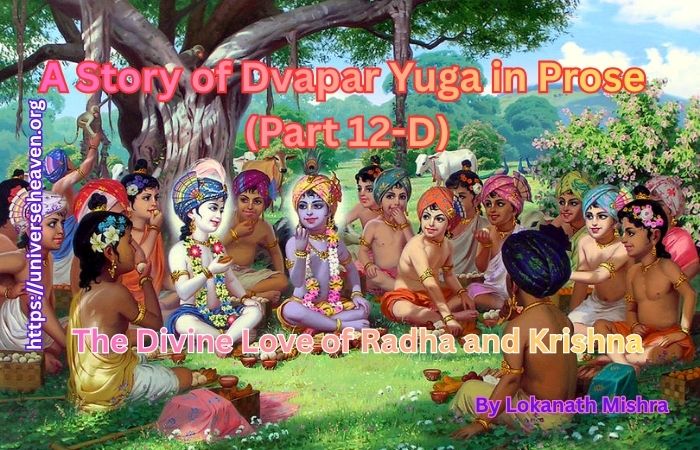
A Story of Dvapar Yuga in Prose ( part 12-D)
By Lokanath Mishra
🌸 The Divine Love of Radha and Krishna 🌸
The story of Radha and Krishna transcends time, religion, and philosophy — it is not merely a tale of love but the eternal dialogue between the soul and the Supreme. Radha represents the human soul’s purest longing, and Krishna symbolizes the divine consciousness that both attracts and fulfills that longing.
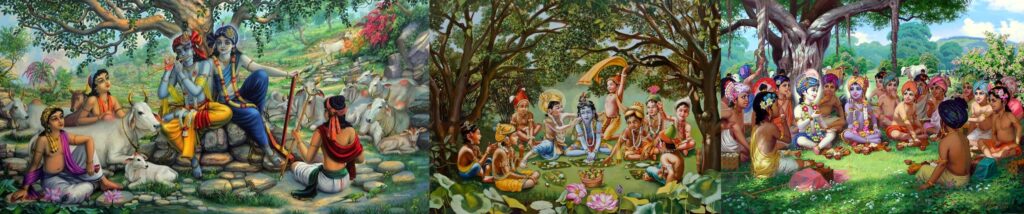
From the forests of Vrindavan to the spiritual realms of Goloka, their love unfolds as a cosmic dance — the Rasa Leela — where devotion surpasses worldly duties and logic dissolves into divine ecstasy. Radha’s love is not desire but surrender; it is not possession but participation in divinity. She embodies Bhakti (devotion) at its highest — selfless, boundless, and unending.
In the spiritual philosophy of Vaishnavism, Krishna is Sat-Chit-Ananda — Existence, Consciousness, and Bliss — while Radha is the power that makes that bliss perceivable. Without Radha, Krishna remains unmanifest; without Krishna, Radha’s love has no direction. They are two names for one truth — the eternal unity of the Lover and the Beloved.
Radha’s simple village life — churning butter, tending cows, walking by the Yamuna — contrasts with her infinite spiritual depth. To her, Krishna is not the cowherd boy of Gokul but the Lord of the universe, her everything. Each time she hears his flute, her soul responds — as every heart responds to the divine call of love.
The Rasa Leela is not an earthly dance but the rhythm of creation itself — the heart of the universe beating in harmony with divine joy. Every gopi in that dance symbolizes a soul yearning for reunion with the divine, and Krishna multiplies himself so that each soul may experience oneness with him. Yet, at the center of this infinite circle stands Radha, the soul of all souls — for through her, the divine love of Krishna finds its fullest expression.
Radha and Krishna’s story thus reminds humanity that true love is neither possession nor passion — it is union beyond separation, devotion beyond duty, and joy beyond reason. Their divine play continues eternally, not just in scriptures and songs, but in every heart that longs for the divine.
There are many views regarding the divine consort Radha. According to the Garga Samhita, Lord Krishna married Radha, the eternal resident of Goloka Dham, during their childhood in the forest of Bhandirvan, with Lord Brahma himself performing the wedding rituals. After this sacred union, their divine play of meeting and separation continued until Krishna departed for Mathura. In such divine descriptions, there is no question of Radha having any other husband. Some even try to argue that Rukmini and Radha are the same, but such a theory does not hold logical or scriptural ground.
Radha and Krishna are one and inseparable — body and soul, nature (Prakriti) and the supreme being (Purusha). Radha is said to be Krishna’s Ahlaadini Shakti, the power of divine bliss. While Krishna controls the universe, Radha alone has the power to control Krishna. This Radha-tattva (principle of Radha) is profound and beyond ordinary comprehension. Born in Barsana to King Vrishabhanu and Queen Kirti, Radha is the eternal consort of Mahavishnu in his Nitya Raas (eternal dance of love). The divine glory of Radha cannot easily be understood by the ordinary mind.
We know of Radha as Radharani, Raseshwari, Rai Kishori, and Rai Vinodini, each depicting her in unique divine plays. In one form, she is a simple cowherd girl — churning curd, preparing butter, milking cows, carrying water from the Yamuna, and selling dairy products in Mathura. Sometimes Krishna captivates her heart; sometimes, for his sake, she endures scolding from the elders.
The Odia Harivamsa describes Radha as being married to Chandrasena, a relative of Yashoda. However, Chandrasena was impotent and spent his days with the cowherds and nights in deep sleep, unaware of Krishna’s secret divine meetings with Radha. Sometimes Radha would call out to Krishna impatiently — “Why have you gone to play your flute?” — while at other times she would be too shy to meet him. Our cultural consciousness is filled with such depictions of their divine leelas (pastimes), beautifully narrated in Odissi songs, Champus, and poetic compositions. To relish these divine works, one must approach them with the simple heart of a gopika (milkmaid) and without logical debate, for their sweetness is beyond reason.
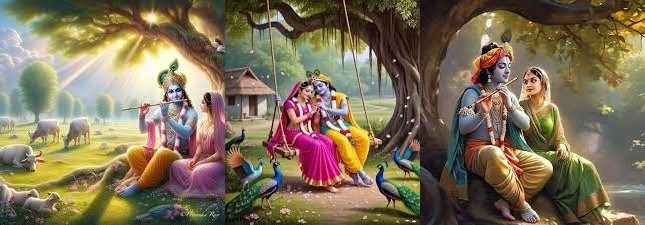
Krishna is known by countless names — Shyamasundara, Natanagara, Bansidhari, Pitavas, Giridhari, Damodara, Gopal, Banamali, Brajakishore, Govinda, and Vrindavanchandra. Some called him Yashoda Dulal (darling of Yashoda), others Nandanandan (son of Nanda), and some poetically addressed him as “the sandal paste adorning the hearts of the women of Braj.” His playful form inspired affection in the hearts of all — parental love in elders, admiration in maidens, and devotion in all.
According to the Bhagavata Purana, during the Rasa Leela (divine dance), Krishna manifested himself into multiple forms so that each gopi could dance with him. The center of this grand Rasa was Radha herself — the supreme beloved of the flute-bearing Lord. In the Nikunjavan, surrounded by melodious flute music, Radha and Krishna danced together while the gopis, through the merits of countless lifetimes, were blessed to join in that celestial dance.
As described in the Odia poetic tradition:
“Govinda thought within himself —
‘Tonight I shall rejoice in Vrindavan.
Sixteen thousand gopis have longed for me through penance;
I shall fulfill their desires, for they are my faithful devotees.
Through many births they have performed austerities,
And now they have become gopis — I shall grant them liberation.’
Thinking thus, Banamali (Krishna) took up his flute.”
It was Kartik Purnima — the full moon shone brightly in the sky, a cool breeze flowed, and by the Yamuna’s bank stood dark-complexioned Krishna, bending in three graceful curves, playing his enchanting flute. The melody called out the names of each gopi, and they, leaving behind husbands, families, and duties, were irresistibly drawn toward him. Their husbands, under Krishna’s divine illusion, did not stop them.
Reaching the Kadamba grove, the gopis beheld Krishna standing beside the supremely beautiful Radha — Pitabasa, the yellow-robed, flute-bearing Lord, adorned with jewels and grace so divine that even millions of Cupids could not rival his beauty.
“Clad in yellow silk, flute in hand,
Lips like blooming lotus petals —
Anklets and bracelets shining bright,
Jeweled girdle upon his waist.
Seeing him, the gopis stood astonished —
Like moths rushing toward a flame,
They trembled, encircling Krishna in ecstasy.”
When the gopis saw Krishna with Radha, they felt a pang of sorrow. Krishna gently told them, “It is not proper to leave your homes at night. You have seen me — now return and serve your husbands.”
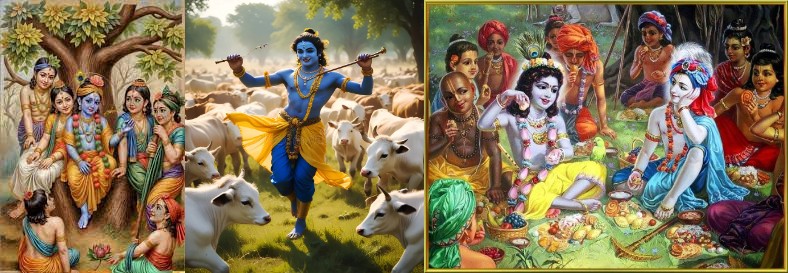
The gopis, heartbroken, pleaded:
“O Banamali! Do not say so. For your sake, we have renounced home, family, and all worldly ties. Do not disappoint us. You are the Lord of all beings — the one whom devotees seek to attain. If you meant to reject us, why did you call us with your flute? Why did you promise to fulfill our desires?”
“Your beauty binds our eyes, O Lord,
None can look away once beheld.
In all the worlds, among all maidens,
None can resist your divine form.”
Moved by their devotion, Krishna spread his arms and said, “Come.” Through his divine power, he multiplied into sixteen thousand forms, embracing each gopi and blessing them with the supreme joy of divine union.
“By the power of illusion divine,
Hari took sixteen thousand forms —
With each gopi, the Lord of Love
Danced the dance of bliss eternal.”
⸻( to be continued)—
କାର୍ତ୍ତିକ ମାହାତ୍ମ୍ୟ (ଭାଗ -୧୪)
A Story of Dvapar Yuga in Prose ( part-21)
କାର୍ତ୍ତିକ ମାହାତ୍ମ୍ୟ(ଭାଗ -୧୫)